The Quick answer
Palm Beach Cosmetic Surgery walks through how eyelid surgery is performed, explaining that blepharoplasty is usually an outpatient procedure taking about an hour, most often done with local anesthesia so you're numb but awake. Upper eyelid surgery hides the incision in the natural crease of the lid, while lower eyelid surgery is done either just below the lash line or through a hidden incision inside the lid, with the transconjunctival approach the only one that typically requires twilight or general anesthesia. Preparation matters as much as the surgery itself, from pausing blood thinners to lining up a ride home. Most bruising and swelling fade within one to two weeks, and results can last five to seven years or longer, which Dr. Michael Sistare reviews during an in-person consultation.
If you’ve been thinking about getting eyelid surgery, also called blepharoplasty, it is completely normal to have a few questions. Because it is a procedure performed so close to the eyes, many people want to understand exactly what it involves before moving forward.
In 2024, eyelid surgery was the most-requested surgical procedure worldwide, with 489,763 procedures for men and 1,625,597 for women, according to ISAPS. Since the skin around the eyes often shows signs of aging first, it is easy to see why so many people choose eyelid surgery when they want to look as refreshed as they feel.
At Palm Beach Cosmetic Surgery in West Palm Beach, FL, board-certified cosmetic surgeon* Dr. Michael Sistare performs upper and lower eyelid surgery with a focus on natural-looking results and honest pricing. This guide walks you through the whole journey. You'll learn how to prepare, what happens on the day of surgery, the upper and lower techniques step by step, and what recovery really looks like.
Key takeaways
- Eyelid surgery, also called blepharoplasty, is usually an outpatient procedure that takes about an hour and is most often done with local anesthesia, so you are numb but awake.
- Upper eyelid surgery hides the incision in the natural crease of the lid. In contrast, lower eyelid surgery is done either just below the lash line or through a hidden incision inside the lid.
- The transconjunctival (inside-the-lid) lower approach is the only one that typically requires twilight or general anesthesia; all other eyelid techniques can usually be done with local numbing.
- Preparation matters just as much as the surgery itself, from pausing blood thinners to lining up a ride home and having someone stay with you the first night.
- Most bruising and swelling usually fade within one to two weeks, and the results of an eyelid lift can last five to seven years or longer.
How should you prepare for eyelid surgery in the weeks before your procedure?

Good preparation starts well before surgery, and it begins with an honest, in-person conversation. Your consultation is a two-way conversation: it gives your surgeon a chance to see whether the procedure fits your anatomy and goals, and it gives you a chance to decide whether the practice feels right for you.
That first visit is where candidacy really gets sorted out. Dr. Sistare reviews your medical history, takes a close look at the skin and fat around your eyes, and talks with you about what you would like to change. Conditions such as glaucoma, dry eye syndrome, diabetes, thyroid disorders, or uncontrolled high blood pressure can affect whether surgery is a good fit, which is why that review matters so much.
Once your surgery is scheduled, a few simple steps will help set you up for smooth healing. They are all manageable, and taking care of them in advance means one less thing to worry about on the day.
- Pause blood thinners and blood-thinning supplements on the timeline your surgeon gives you: aspirin, ibuprofen, vitamin E (often part of a daily multivitamin), and supplemental levels of garlic, ginseng, ginkgo, turmeric, or fish oil. Also skip alcohol for two weeks before surgery and two weeks after.
- Stop smoking and vaping for several weeks before surgery, since nicotine narrows blood vessels and slows healing.
- Stock up on recovery basics: gauze, any prescribed eye drops or ointment, and a couple of extra pillows to keep your head elevated.
- Arrange for a trusted adult to drive you home and stay with you the first night, since you won't be able to drive yourself.
Cost is part of this stage, and we believe in being upfront about it. At our practice, upper eyelid surgery starts at $3,500, with monthly payment options available through financing. Pricing for lower or combined eyelid surgery is confirmed during your consultation. If you are still weighing your options, scheduling a consultation is the best way to get clear answers without any pressure to decide right away. Taking the time to research your options carefully is exactly the right instinct.
What happens on the day of surgery before the first incision is made?
By the time you arrive, most of the big decisions are already behind you, so the day usually feels calmer than people expect. Before the first incision, a few careful steps are taken, all with your comfort and safety in mind.
An eyelid surgery starts with local anesthesia, which numbs the area so you stay awake and relaxed without feeling the procedure. The main exception is the transconjunctival lower approach, done inside the lid, which usually requires twilight sedation or general anesthesia so you are fully asleep.
Next, your surgeon marks your eyelids while you are sitting upright. That matters because gravity changes how the skin sits when you lie down, and marking you this way helps your surgeon map out the incisions and the exact amount of tissue to address. It is a small step, but it plays a big role in getting a precise result.
Then the area is cleaned and carefully prepped to keep everything sterile, and protective shields or lubrication is applied to the eyes. These shields help protect the surface of your eye throughout the procedure. Once you are numb, marked, and ready, the surgery begins and usually lasts about an hour.
How is an upper eyelid blepharoplasty performed step-by-step?
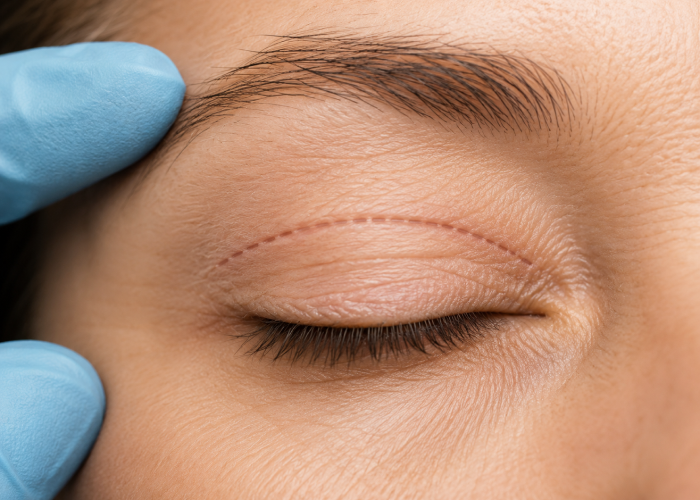
Upper eyelid surgery follows a straightforward sequence, and Dr. Sistare plans each step to keep the result as discreet as possible. The goal is a lid that looks naturally refreshed, not obviously operated on.
It starts with the incision, placed right in the natural crease of your upper lid. Because the cut follows a fold your eye already has, the resulting line is tucked out of sight once healed. From there, your surgeon gauges how much loose skin to remove, carefully leaving enough behind so the eye still closes fully and comfortably.
Underneath the skin, a little more happens. Your surgeon removes or repositions the small pockets of fat that cause puffiness, and may adjust the underlying muscle when needed for a smoother contour. The incision is then closed with fine sutures along the crease. One reassuring point: bruising is usually minimal with upper eyelid surgery, unless you take a blood thinner like aspirin.
AMM, a patient at our West Palm Beach office, described feeling at ease during surgery:
"Dr. Sistare succeeded 100% at keeping me safe during my procedure and providing me with an excellent surgical outcome. His pleasant demeanor put me immediately at ease and I felt cared about as he took the time to thoroughly answer all of my questions during consultation."
Seeing real results can make everything feel a lot less abstract. You can take a look at our eyelid surgery photo gallery to see how these techniques translate into natural-looking outcomes. If you are starting to think about your next step, that is often a helpful place to begin before scheduling an appointment.
How is a lower eyelid blepharoplasty performed step-by-step?
Lower eyelid surgery targets puffiness and bags beneath the eyes, and the biggest decision is where to place the incision. There are two main approaches, and the right one depends on whether your main concern is bulging fat or loose skin. Both are performed at Palm Beach Cosmetic Surgery.
| Approach | Where the incision goes | Best suited for | Closure |
|---|---|---|---|
| Subciliary (transcutaneous) | Just below the lower lash line | Excess or loose skin below the lash line | Fine non-dissolvable sutures, removed after a few days |
| Transconjunctival | Hidden inside the lower lid | Bulging fat with little excess skin | Often, there are no sutures at all, and no external scar |
When bulging fat is the concern, the fat is removed or repositioned rather than simply cut away. That smooths the area, keeps the transition to your cheek looking natural, and helps avoid a hollow or sunken appearance. When loose skin is the concern, the subciliary approach removes a thin strip of skin just below the lash line.
Sometimes the lower lid margin loosens with age, and in those cases, your surgeon may recommend a canthopexy, which is a small tightening of the tendon at the outer corner that helps support the lid and reduce sagging. It is also important to note that some functional lid conditions, such as ptosis or entropion, are outside the scope of cosmetic eyelid surgery, so we refer those cases to a dedicated oculoplastic surgeon.
What does the immediate recovery period look like at the surgical facility and at home?
Recovery begins as soon as surgery is over, and the first few hours are usually easier than most people expect. You'll spend a little time in the recovery area until you are steady and alert, then go home the same day with someone to drive you. It is also normal to feel a bit blurry, watery, or tight around the eyes right away, and this usually eases as the numbing wears off and swelling settles.
The first three days have a simple rhythm. Your surgeon will have you apply gentle heat for 20 minutes, then cool compression for 20 minutes, repeated every couple of hours to reduce swelling and speed healing. A few other habits round out that first week.
- Use any prescribed antibiotic ointment or eye drops exactly as directed to keep the incisions clean.
- Keep your head elevated, especially while sleeping, for the first several nights to limit puffiness.
- Rest your eyes and avoid strenuous activity, heavy lifting, and bending for the first week; short, easy walks are encouraged.
- Hold off on eye makeup and contact lenses for about two weeks.
Discomfort is usually mild and manageable with over-the-counter medication, and a stronger prescription is rarely needed for more than a few days. Most bruising and swelling fade within one to two weeks, which is also when many people return to work and daily life. If you'd like to soften the fine incision lines later, silicone scar products are best started about six weeks after surgery, once everything is fully closed.
This is where after-care really matters, and our team takes it seriously. From clear written instructions to easy follow-up access, we stay with you long after you leave the office.
Cole, an under-eye blepharoplasty patient at our West Palm Beach office, shared their recovery experience:
"Post-operative follow-ups were seamlessly handled, with the staff remaining available for any questions I had and providing thorough instructions for recovery. I highly recommend Palm Beach Cosmetic Surgery to anyone considering plastic surgery."
For those considering eyelid surgery, consulting a plastic surgeon in Palm Beach can help clarify the available options, expected results, and recovery process.
If cost is a concern, you can explore flexible financing through Cherry, CareCredit, and Alphaeon Credit to find a monthly plan that works for your budget. The goal is for cost not to be what keeps you from feeling like yourself again.
Conclusion
So, back to the question you started with: what really happens during eyelid surgery? Now, you finally understand that it is a carefully planned outpatient procedure that usually takes about an hour. Most of it is done while you are comfortably numb, and each step is designed to create a natural-looking result with a smoother recovery than many people expect.
A helpful next step is to review the work yourself. Real patient before-and-after photos can show what is realistically possible with upper and lower eyelid surgery. From there, a consultation turns those results into a plan tailored to your eyes and goals.
When you are ready, the team at Palm Beach Cosmetic Surgery is here to guide you through the next step with clarity and no pressure. It is simply a conversation about your eyes and your options. You can schedule your personal consultation with Dr. Sistare at our West Palm Beach office or call 561-499-9000 to get started. Your journey to confidence begins here.
Frequently asked questions
Will you be fully awake during eyelid surgery?
For most eyelid surgery, yes. The area is numbed with local anesthesia, so you stay awake and comfortable without feeling the procedure. The main exception is the transconjunctival lower approach, which is done inside the lid and usually requires twilight sedation or general anesthesia.
Does blepharoplasty leave noticeable scars?
Incisions are placed to hide well, in the natural crease of the upper lid, just below the lash line, or entirely inside the lower lid. Once fully healed, these lines are typically very hard to notice. Careful incision placement and good aftercare both help minimize scarring.
How long does the entire eyelid surgery procedure take?
Most eyelid surgery takes about an hour from start to finish, and because it is done as an outpatient procedure, you can usually go home the same day. If you are combining upper and lower lids or adding another facial procedure, the surgery may take longer. You will also spend a little time in the recovery area before heading home.
Is eyelid surgery painful to undergo?
Most people are surprised by how manageable it is. Discomfort is usually mild and well controlled with over-the-counter medication, and a stronger prescription is rarely needed for more than a few days. Some tightness and mild soreness are normal parts of early healing.
When can you safely return to work after a blepharoplasty?
Many people return to work and daily activities within 1 to 2 weeks once the most visible bruising and swelling have faded. Desk-based work is often possible sooner than more physical jobs. Your surgeon will give you a timeline based on how you're healing.
Can you drive yourself home immediately after eyelid surgery?
No. Because your vision may be blurry and you may have had sedation, you'll need a trusted adult to drive you home and ideally stay with you the first night. Our office coordinates with you in advance so that a ride is arranged before your surgery date.
Does health insurance cover blepharoplasty?
Purely cosmetic eyelid surgery is not covered by insurance. That said, upper eyelid surgery may qualify for partial coverage when drooping skin significantly blocks your vision, and this usually requires an eye exam and photos documenting the impairment. Lower eyelid surgery is generally considered cosmetic.
What is the difference between cosmetic blepharoplasty and ptosis repair?
Cosmetic blepharoplasty removes or repositions excess skin and fat to refresh the eye's appearance. Ptosis repair is a functional surgery that tightens the muscle responsible for lifting the eyelid when it droops, affecting vision. We refer ptosis cases to a dedicated oculoplastic surgeon rather than treating them as cosmetic procedures.
What should you do if your eyes feel extremely dry or blurry after the procedure?
Temporary dryness and blurriness are common in the first few days as the area heals, and lubricating drops usually help. Be sure to follow the drops and ointment schedule you are given, and rest your eyes often. If the dryness or blurred vision lingers or gets worse, contact your surgeon's office so it can be checked.
Are the results of an upper or lower eyelid lift permanent?
Eyelid surgery results are long-lasting, often lasting five to seven years or more, even as your eyes continue to age naturally. A healthy lifestyle and good sun protection can help you keep those results looking their best. If you are wondering what your own results might look like, a consultation is the best way to get personalized answers.
*Disclaimer: The specialty recognition identified herein has been received from a private organization not affiliated with or recognized by the Florida Board of Medicine. Financing terms vary by credit approval. This content is for educational purposes only and does not constitute medical advice. A consultation with a qualified board-certified surgeon is required to determine the best treatment plan for your individual needs and any questions you may have about a medical condition or procedure.