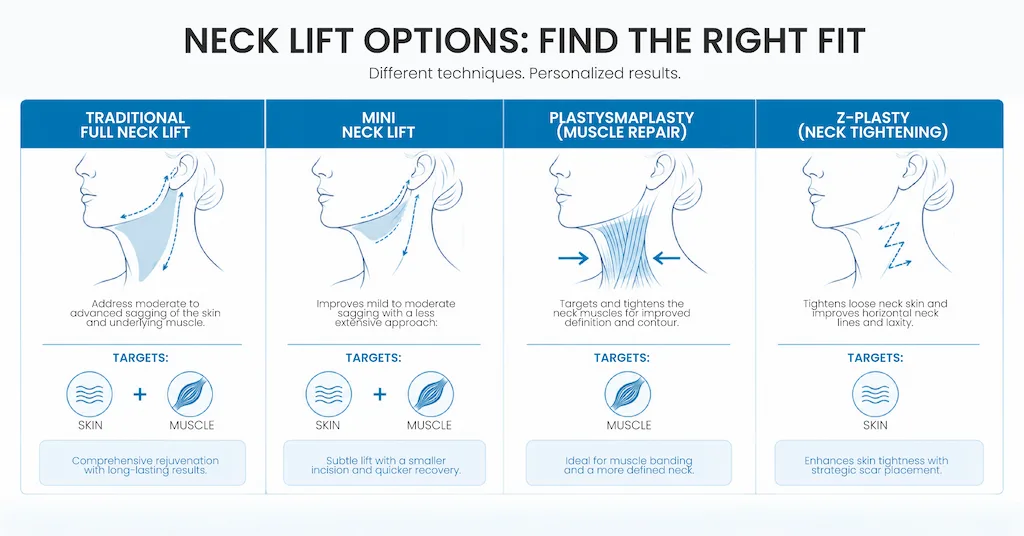
You started by Googling “neck lift,” expecting one procedure. Three tabs in, you have a list. Platysmaplasty, cervicoplasty, Z-plasty, traditional neck lift, deep plane neck lift, neck liposuction. Each article uses a different name for what looks like the same operation.
That gap, between the simple answer you wanted and the menu you found, is exactly what this article is here to sort out. These are real techniques, not marketing labels. Each one targets a different layer of the neck: skin, fat, or muscle.
In 2024, 13,372 Americans aged 55 to 69 chose a neck lift, about six in every ten patients who had the procedure. The technique each of them received was not the same.
At Palm Beach Cosmetic Surgery in West Palm Beach, FL, consultations often start with figuring out which technique actually fits the neck across the desk. This guide walks through every major neck lift type, what each one does, who it suits, and how surgeons choose between them. Matching technique to anatomy is exactly what you'd want from comprehensive cosmetic surgery services.
Key Takeaways
A few patterns worth keeping in mind as you read:
- “Neck lift” is a category, not a single operation. The right technique depends on whether the main concern is skin, fat, muscle bands, or some mix of all three.
- Platysmaplasty tightens the platysma muscle (the flat sheet of muscle running from your collarbone to your jaw) to address visible neck cords. Cervicoplasty removes excess skin. Z-plasty is a niche option held in reserve for specific cases, like a patient who can’t safely undergo a traditional neck lift or who has a contracting scar from a previous direct neck lift.
- Platysmaplasty and neck liposuction work for early changes or fat-driven concerns. Traditional and deep plane neck lifts handle more advanced sagging, and a face-and-neck lift is common when the lower face is involved too.
- Most patients are back to non-physical work in about three days, once they’re off prescription pain medication, with bruising and swelling settling over about two weeks. The final shape is usually visible within one to three months, and results often last 10 to 15 years.
- The best technique is the one matched to your anatomy by an in-person assessment—not the one that sounds most familiar online.
What Are the Main Types of Neck Lift Procedures?
A neck lift is any operation that improves the contour of the neck and jawline. The category includes several distinct techniques.
Some focus on muscle. Some focus on skin. Some focus on fat.
Board-certified cosmetic surgeon Dr. Michael Sistare offers the major neck lift options at the West Palm Beach office. The first step in any consultation is identifying which technique actually solves the problem at hand.
| Technique | What it targets | Best for |
|---|---|---|
| Traditional / full neck lift | Skin, muscle, and fat together | Moderate-to-severe laxity across the neck |
| Platysmaplasty | The platysma muscle and visible bands | Vertical neck cords with mild fat |
| Cervicoplasty | Excess sagging skin only | Significant skin redundancy without major muscle work |
| Z-plasty neck lift | Severe central skin redundancy | Patients medically unable to have a traditional neck lift, or a contracting scar from prior neck surgery |
| Deep plane neck lift | Structures beneath the platysma | Profound, longer-lasting rejuvenation |
| Neck liposuction | Stubborn submental fat | Younger patients, fat-only concerns |
Traditional and Full Neck Lift
A full neck lift is among the most comprehensive neck lift procedures available in Palm Beach, removing excess skin, tightening the platysma muscle, and reducing fat in one operation. It’s the right call when more than one issue is at play. Recovery generally runs 10 to 14 days.
Platysmaplasty
Platysmaplasty targets the platysma, the thin sheet of muscle that runs from the collarbones to the jaw. As the muscle separates with age, it forms two visible cords down the front of the neck. Platysmaplasty rejoins the muscle in the midline. More detail on this in the next section.
Cervicoplasty
Cervicoplasty focuses on skin. When the main issue is excess, sagging neck skin, and the muscle underneath is still holding its shape, a surgeon can remove only the loose skin without touching the muscle. It’s often combined with a platysmaplasty when both layers need attention.
Z-Plasty Neck Lift
Z-plasty is an uncommon technique kept in reserve for specific situations rather than routine aging. Dr. Sistare generally considers it only for patients who aren’t medically stable enough for a traditional neck lift, or who have a contracting scar on the front of the neck from a previous direct neck lift. The incision is shaped like a Z so the resulting scar runs along several directions of skin tension instead of one straight line.
Deep Plane Neck Lift
A deep plane neck lift is the more advanced option, working beneath the platysma to address structures that standard surgery doesn’t reach. Because it releases and repositions the deeper layer, it tends to produce a longer-lasting result, which is why it’s often chosen when the goal is durable rejuvenation rather than a lighter touch-up.
Neck Liposuction
Neck liposuction is the lightest option. When the issue is isolated fat under the chin and the skin is still elastic enough to snap back on its own, lipo surgery alone may be enough. It’s often added to a neck lift rather than performed solo.
If this list raised more questions than it answered, that’s exactly what a consultation is for. To talk through which technique fits your specific neck, request a consultation at our West Palm Beach office.
How Does Platysmaplasty Work, and Who Is It Best For?

Platysmaplasty is one of the most commonly added steps inside a broader neck lift. It’s the muscle work that gives you a smoother neck and a more defined angle between your chin and neck.
The platysma is a thin sheet of muscle that covers most of the front of the neck, attaching to the collarbones below and the lower jaw above. With age, the platysma muscle becomes lax and the supporting fascia attenuates, causing the medial edges of the muscle to separate and become visible as vertical neck bands. About 75% of people have an anatomical pattern that makes these bands more pronounced as the muscle ages.
Simple vs. Corset Platysmaplasty
There are two main stitching variations. Both rejoin the muscle in the middle, they just take different routes to get there.
A simple platysmaplasty stitches the inner edges of the muscle together side by side. A corset platysmaplasty uses a continuous suture that travels up and back down the center, cinching the muscle inward as it goes, similar to how a corset tightens. The corset version tends to hold longer, especially when combined with comprehensive facial cosmetic surgery options.
Either approach is done through a small opening under the chin, usually 2 to 4 centimeters long. Sometimes that’s paired with small incisions behind the ears when there’s also skin to remove. The choice between the two comes out of your consultation.
Who Is a Good Candidate?
Patients in their 40s to early 60s with visible cords, mild excess fat, and reasonably elastic skin tend to be the strongest candidates for a standalone platysmaplasty. Patients over 60 with significant loose skin generally need the skin-removal component of a full neck lift on top of the muscle work. Men with thicker platysma muscle anatomy may also benefit from the corset variation.
Long-term outcomes are well studied. A 13-year follow-up reported 82% to 95% sustained improvement in the cervicomental angle. Complication rates in larger patient series sit below 5%.
What Is Cervicoplasty, and When Should You Choose It?
Cervicoplasty is strictly about skin. When the platysma is still doing its job and the only issue is loose, sagging neck skin, removing the skin alone often makes more sense than a full neck lift.
The typical candidate is older, has noticeable skin looseness that no longer responds to creams or energy-based treatments, and wants a defined jawline back without the broader dissection of a full facelift. These are sometimes called “difficult necks” in surgical literature, common after major weight loss or in patients whose skin has aged faster than the underlying muscle. If loose neck skin is your main concern, what actually tightens a turkey neck compares every option that addresses it.
Cervicoplasty incisions are designed to blend in. A direct excision is sometimes done through a curved “wave-plasty” pattern marked while the patient is sitting upright. Other variations use incisions beneath the chin, behind the ears, or along the midline, depending on where skin is most redundant.
The procedure can be combined with a platysmaplasty in the same session, which is common when both layers are loose. Combined cervicoplasty-platysmaplasty procedures have shown around 81% patient satisfaction in published series, with durable results out to five years.
The real difference between cervicoplasty and a full neck lift is scope. Cervicoplasty handles the skin with smaller scars and a faster recovery, leaving everything else alone when it doesn’t need to be touched. Cost is a real part of the decision for almost everyone. To explore financing through Cherry, CareCredit, and Alphaeon Credit, take a look before your consultation.
What Is a Z-Plasty Neck Lift, and Is It Right for You?
Z-plasty is a niche technique that Dr. Sistare keeps in reserve for a narrow set of patients. It isn’t an aesthetic upgrade over a standard neck lift; it’s a problem-solver for two specific situations, and for the patients who genuinely need it, it can accomplish in one operation what almost nothing else can.
The technique starts with a Z-shaped marking on the front of the neck. The redundant skin and fat above and below the platysma are removed. The platysma is tightened. Triangular flaps of skin are then repositioned across the closure to break up any straight-line scar, lengthening the underlying tissue by roughly 75%.

Who Is Z-Plasty Actually For?
Z-plasty is reserved for two scenarios. The first is a patient whose overall health makes a longer, traditional neck lift too risky, so a shorter, more limited procedure is the safer way to address the neck. The second is someone left with a contracting scar on the front of the neck from a previous direct neck lift, where the Z-shaped closure releases that tension and redistributes it.
Dr. Sistare weighs your health, anatomy, and surgical history together before considering Z-plasty. For the typical aging neck, the conversation almost always points toward a platysmaplasty, a traditional neck lift, or a deep plane neck lift instead.
Recovery from a Z-plasty is generally quick because the procedure is limited in scope. Mild bruising clears in about two weeks, and most patients are back to non-physical work within a few days.
Deborah C., a patient at our West Palm Beach office who chose neck-lift surgery after reviewing other patients' results, shared her experience:
"I am above and beyond happy with the smartlift facial surgery and necklift surgery I recently had done by Dr. Sistare. After seeing many of his patients' results, I decided to have my surgery done by Dr. Sistare. Throughout the whole journey, he and his fabulous staff were and are amazing."
What Is the Neck Lift Procedure Like, Step by Step?
Whatever combination of techniques you and your surgeon settle on, the actual day of surgery follows a familiar sequence. Knowing the order makes it feel a lot less like an unknown.
Anesthesia and Positioning
Most full neck lifts are done under general anesthesia or IV sedation with local numbing. Smaller procedures like an isolated Z-plasty can sometimes be performed under local anesthesia in an office setting. Either way, you won’t feel anything during the surgery itself.
Incisions
Your surgeon places incisions in spots that will be hidden once they heal. The standard pattern includes a discreet line behind the ears, sometimes extending into the hairline, with a small opening under the chin when muscle work or fat removal is needed.
Fat Removal
If excess fat is part of the picture, it’s usually addressed early in the operation. Submental fat (the fat directly under the chin) is removed through small openings using liposuction. Subplatysmal fat (fat sitting beneath the muscle layer) is sometimes removed directly when deeper fullness is the main concern.
Platysma Muscle Tightening
This is the platysmaplasty step inside a broader neck lift. Your surgeon trims the medial edges of the platysma and rejoins them in the midline using either an edge-to-edge stitch or a corset-style running suture. If side bands are still loose, a small lateral suspension is added to address them.
Skin Redraping
Once the deeper structures are tightened, any excess skin is gently lifted, repositioned over the new contour, and trimmed. The remaining skin is closed with fine sutures along the planned incision lines.
Time in the Operating Room
A neck lift generally takes about 2 to 4 hours, depending on the complexity and whether it’s combined with other procedures. Most are outpatient, meaning you go home the same day.
What Recovery and Results Should You Expect?
Recovery looks a little different depending on the technique, but the general arc is the same. The first two weeks are about swelling and bruising. The month after that is about looking and feeling like yourself again. The final result settles in over the months that follow.
Dr. Sistare sends you home from the surgery center with a light compressive headwrap, which comes off the next day at the office. After that, no ongoing compression is required unless you find it comfortable. Most patients need prescription pain medication for only about three days, then over-the-counter relief handles the rest.
| Recovery milestone | Typical timing |
|---|---|
| Bruising clears | 4 to 5 days for mild cases, up to 2 weeks for traditional |
| Swelling drops noticeably | 2 to 3 weeks |
| Return to non-physical (desk) work | About 3 days, once off prescription pain meds |
| Light exercise resumed | 2 to 3 weeks |
| Strenuous exercise resumed | 4 to 6 weeks |
| Final contour visible | 1 to 3 months |
| Incisions fully matured | About 6 months |
Isolated neck liposuction and a standalone platysmaplasty tend to fall on the faster end. Traditional and combined face-and-neck lifts sit at the longer end. Z-plasty patients often recover quickly because the surgery is more limited in scope.
Long-term, neck lift results commonly last 10 to 15 years. Deep plane neck lifts sit on the longer side of that range.
To extend your result: use SPF 30 or higher daily to protect against sun damage. Keeping your weight stable and getting steady sleep helps tissues hold their new position. For ongoing muscle-band activity, occasional neuromodulator treatments for expression lines every 3 to 6 months can extend the smoothing effect of the original surgery.
What Does a Neck Lift Consultation Involve at Palm Beach Cosmetic Surgery?

The consultation is where the full menu narrows down to the one or two techniques that actually fit you. It’s not just a chance for a surgeon to evaluate you, it’s equally your chance to evaluate the surgeon and decide if this is a team you want supporting you through recovery.
A consultation at our West Palm Beach office begins with an in-person evaluation. Dr. Sistare assesses skin elasticity, muscle separation, fat distribution, and the underlying bone structure that influences the chin-to-neck angle. The conversation that follows covers your goals in your own words, and from that, a recommended technique or combination is laid out with the reasoning behind it.
In-person matters here. A hands-on assessment of skin character and muscle laxity isn’t something a screen can replicate. Consultations are complimentary, and the practice doesn’t charge for the garments you’ll need afterward either. Every visit includes a personal walk-through of the office, the team, and the recovery setup.
Charlotte G., a patient at our West Palm Beach office, described her consultation experience this way:
"I had a fantastic experience at Dr Michael Sistare's office. From the moment I walked in, the staff was warm and welcoming. Dr. Sistare was incredibly informative and took the time to thoroughly explain every step of the process, which made me feel completely at ease."
Cost comes up in every consultation, and it’s a fair part of the conversation. Pricing varies by technique and by what gets combined into one operation. Flexible financing through Cherry, CareCredit, and Alphaeon Credit makes monthly payment plans available.
If you’d like to walk in already knowing what you’re leaning toward, schedule your consultation at our West Palm Beach office, or call 561-462-4469.
Conclusion
You started this article in a tab fight, scrolling between technique names that all sounded close enough to be confusing. Now the names have anatomy attached.
Platysmaplasty is for muscle. Cervicoplasty is for skin. Z-plasty is a niche fix reserved for specific situations. A traditional or deep plane neck lift handles the more common case where two or three layers are loose at once.
Browsing real patient results for each of these techniques is one of the most useful next steps. Photos make abstract decisions concrete in a way that words cannot, and a personal consultation fills in the rest.
When you are ready, Dr. Sistare and our team in West Palm Beach, FL are here to help you sort out which technique fits your anatomy, your goals, and your budget. Reach out through our consultation request page. Your journey to confidence is one you should walk into already feeling supported.
Frequently Asked Questions
What is the difference between platysmaplasty and cervicoplasty?
Platysmaplasty tightens the platysma muscle in the front of the neck, addressing visible vertical bands or “cords.” Cervicoplasty removes excess sagging neck skin along the jaw and under the chin. The two are often combined when both layers need attention. They are not interchangeable.
How long does a neck lift last?
Most neck lift results last 10 to 15 years. Deep plane neck lifts sit on the longer end because they address structures other techniques leave alone. Skin quality, sun exposure, weight stability, and lifestyle all influence how long results hold.
Is a neck lift painful?
Most patients describe the post-op discomfort as manageable and milder than they expect. Most need prescription pain medication for only about three days, with over-the-counter relief after that. A snug feeling around the neck during early healing is common and eases as swelling drops.
Can I get a neck lift without a facelift?
Yes. A neck lift is a stand-alone procedure when the upper face isn’t a concern. Many patients choose to combine the two when there’s also jowling or midface sagging, since doing them together often produces a more balanced result through a single recovery period.
How much does neck lift surgery cost?
Cost varies by technique, by whether you combine it with a facelift, by the operating facility, and by anesthesia. A real number requires a personalized estimate at consultation. Flexible financing through Cherry, CareCredit, and Alphaeon Credit is available to spread the cost into manageable monthly payments.
Are there non-surgical alternatives to a neck lift?
For early or mild changes there are non-surgical options, though Dr. Sistare generally doesn’t recommend energy-based devices like Ultherapy or fat-dissolving injectables like Kybella, since their results tend to be modest and short-lived. Targeted BOTOX can soften dynamic platysmal bands for a few months at a time. None of these replace what a neck lift does for moderate-to-severe sagging, but they can buy time before surgery makes sense.
What is corset platysmaplasty?
Corset platysmaplasty is a stitching variation that uses a continuous suture running up and back down the midline of the platysma muscle, cinching it from side to side as it goes—similar to how a corset tightens. It’s often chosen when extra durability is needed, especially when combined with a facelift.
Who is not a candidate for a neck lift?
Active smokers, people with uncontrolled medical conditions, those with bleeding disorders, and patients with unrealistic expectations are generally not good candidates. The right time for a neck lift is when health is stable, goals are clear, and the anatomy actually matches what surgery can change.
Does a neck lift remove a double chin?
Often, yes. When a double chin is driven by submental fat or loose neck skin, the right combination of liposuction, cervicoplasty, or platysmaplasty within a neck lift can reduce or eliminate it. When the fullness sits deeper, beneath the muscle, a deep plane neck lift can reach and address it.
Who is a Z-plasty neck lift for?
It’s a reserved technique, not a routine one. Dr. Sistare generally considers Z-plasty only for patients whose health makes a traditional neck lift too risky, or who have a contracting scar on the front of the neck from a previous direct neck lift. For ordinary aging concerns, a platysmaplasty or neck lift is the better fit.
Can a neck lift fix jowls?
A neck lift on its own usually doesn’t fully correct jowls, since jowls form along the lower face. A combined face-and-neck lift is the more common solution when jowls and neck sagging coexist. It lifts the lower face and tightens the neck through one set of incisions and one recovery period.
What are the risks of a neck lift?
Serious complications are uncommon with an experienced surgeon, overall rates are reported below 2% in larger patient series. Possible issues include temporary fluid buildup beneath the skin, brief changes in sensation, and minor wound healing concerns. Booking with a board-certified cosmetic surgeon and following the recovery plan closely keeps those numbers low.
**Disclaimer: The information is intended for educational purposes only and should not be considered medical advice. Every patient's anatomy, health history, and goals are unique, and outcomes, recovery timelines, and candidacy may vary. The only way to determine whether the procedure is right for you is through a one-on-one consultation with a board-certified cosmetic surgeon. Always discuss your specific concerns, risks, and expectations with your provider before making any decisions about surgery. The specialty recognition identified herein has been received from a private organization not affiliated with or recognized by the Florida Board of Medicine."