The question, “Is it the right time to get a facelift” doesn’t usually arrive in one big moment. It builds. Maybe you’ve started turning your head a certain way for photos. Maybe a longtime friend looks more rested after a holiday and you find yourself wondering what changed. Or maybe you’ve quietly priced things out, twice, before closing the tab.
If you’ve landed here trying to figure out when a facelift makes sense, not whether, you’re already past the hardest part. The harder questions now are about timing, technique, and how long the results will hold up.
You’re far from alone in weighing this. According to ISAPS, 737,028 facelifts were performed worldwide in 2024, a 7.4% jump from the year before. The age range and the reasoning behind those decisions are wider than they used to be, and the timing question is now part of almost every consultation.
At Palm Beach Cosmetic Surgery in West Palm Beach, FL, our experienced cosmetic surgery team matches the procedure to your anatomy and goals rather than to a calendar age. This guide walks through the signs that tend to mean it’s time, how the decision shifts by decade, which facelift type fits each stage, how long results last, and what candidacy looks like in practice.
Key Takeaways
A few patterns are worth carrying with you before you read further.
- The right time for a facelift is set by your anatomy and health, not your birthday. Specific, correctable changes, jowling, descent and atrophy of the cheek fat pads, plus skin laxity (how much your skin and underlying tissue have loosened or sagged), weight stability, and overall health, matter far more than the calendar.
- Decade is a useful frame: most 30s patients do better with non-surgical care, the 40s often suit a mini facelift, the 50s are commonly called the sweet spot, and healthy 60s and 70s patients can still be excellent candidates.
- The three main facelift types address different depths. A mini facelift handles early changes with a quicker recovery, a traditional SMAS (Superficial Musculoaponeurotic System) lift addresses moderate laxity, and a deep plane facelift releases the deeper tissue layer for more natural movement and longer-lasting results.
- Facelift results commonly last 10 years or more, with mini lifts running roughly 5 to 10 years and deep plane lifts often holding 10 to 15 years. Sun protection, steady weight, skincare, and not smoking extend that range.
- A strong consultation is a two-way evaluation, not an audition. Use it to find out whether the timing is right for your face, your health, and your life, with no expectation to commit at the visit.
What Are the Main Signs That You’re Ready for a Facelift?
Most people don’t pick a date and then look for reasons. They notice a few specific changes, ignore them for a while, and then admit to themselves that the changes aren’t going back. That admission is usually the real starting point. The signs below are the ones surgeons hear most often in consultation.
Dr. Sistare frames it simply: age itself isn't the trigger. What matters are the specific, correctable changes in the face, jowling, the downward descent of the cheek fat pads, and the volume loss (atrophy) that comes with them. He also shares a quick self-check: stand in front of a mirror and gently lift your cheeks up and back with your fingertips. If that movement gives you the look you're after, it's a strong sign that a facelift could deliver it for you.
Jowls and a Softening Jawline
A defined jawline depends on three things working together: skin elasticity, the SMAS layer (the deeper sheet of muscle and connective tissue under your skin), and the fat pads that sit along the cheek. When elasticity drops, those fat pads slide downward and begin to lose volume (atrophy), and the line from your ear to your chin softens as small pouches form along the lower face. That’s a jowl, and it’s the change that most often pushes someone from “thinking about it” to “researching it.”
Fillers can mask early softening for a while by adding volume above the line. Once the underlying tissue has actually descended, though, more filler tends to look heavier rather than lifted. That shift is one of the clearest signs that surgery is back on the table.
Loose Skin in the Cheeks and Neck
Skin laxity in the lower face and the neck usually shows up around the same time. You may notice the area below your jaw looks less crisp on video calls, or the skin folds slightly when you turn your head. Loose skin around the neck is one of the core indicators that someone is a good candidate for a facelift, often combined with sagging skin under the chin treatment for a smoother result.
Folds That Fillers Used to Handle
The lines from your nose to the corners of your mouth (nasolabial folds) and from your mouth to your chin (marionette lines) deepen with age. Dermal filler options for volume loss can soften them when the underlying anatomy is still mostly in place. When you find yourself needing more product to get the same effect, or your provider tells you a touch-up isn’t going to do it, that’s the structural piece talking.
A Tired Look That Doesn’t Match How You Feel
This one comes up in almost every consultation. You feel like your usual energetic self, then catch your reflection and find someone who looks worn out. The disconnect is its own data point, and one of the strongest signals that surgery is worth a serious look.
If two or three of these signs are showing up at once, the timing conversation has effectively started. The next question is what your decade has to do with it.
How Does the Right Facelift Timing Change by Decade?

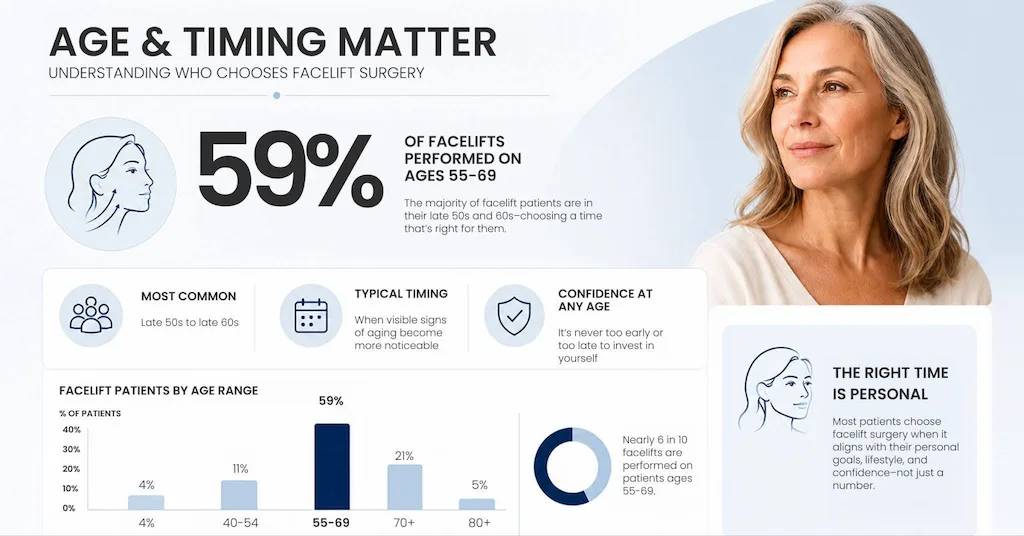
Decade is a useful frame, but it’s not destiny. According to ASPS, 59% of U.S. facelifts in 2024 were performed on patients ages 55 to 69, but the remaining 41% are spread across people in their 30s, 40s, and 70s+. What follows is a rough map of how the conversation usually goes at each stage. Keep in mind that age on its own doesn't decide it, the correctable changes in your face, jowling, fat pad descent, and volume loss, are what determine whether surgery will actually help.
In Your 30s
Most people in their 30s are not facelift candidates. Skin elasticity is usually still strong, and bone structure hasn’t shifted much. The work that holds up best in this decade is preventive and non-surgical: a steady skincare routine, daily sunscreen, neuromodulators (such as BOTOX®) for early dynamic lines, and small amounts of filler if needed.
There are exceptions. People with significant sun damage, dramatic weight loss, or genetic early laxity sometimes start asking about a mini facelift in their late 30s. In most of those cases, your surgeon will still steer the conversation toward energy-based skin tightening and injectables first, with a mini facelift as a future option rather than a current one.
In Your 40s
This is where the conversation gets real. Many patients in their early to mid-40s start to see jawline softening that injectables alone can’t fully address. A mini facelift aimed at restoring a youthful facial appearance is often a fit here, with shorter incisions around the ears, a quicker recovery, and a focus on mild to moderate sagging in the cheeks and jawline.
If the laxity is more advanced, or if you're combining the procedure with upper eyelid surgery, your surgeon may recommend a more comprehensive approach. The deciding factor isn’t your birthday. It’s how much tissue has actually moved.
In Your 50s
The 50s are often called the sweet spot, and there’s a reason. Skin elasticity is usually still good enough for results to settle smoothly, the changes from gravity and fat pad shift are visible enough to make surgery worthwhile, and most patients are in good general health. A traditional SMAS facelift or a deep plane facelift, often combined with a neck lift, is the most common path in this decade.
Choosing this window also tends to mean you only need one major lift in your lifetime, especially if you maintain steady weight, sun protection, and skincare.
If you’re ready to start mapping your own timing to your anatomy and goals, you can book a consultation with our West Palm Beach team to talk through your options in person.
In Your 60s and Beyond
Healthy patients in their 60s, 70s, and even older can be excellent candidates. There’s no specific age requirement, and overall health matters more than birthday year. Tissue laxity is usually more pronounced at this stage, so a deep plane facelift combined with a neck lift is often the right combination for natural-looking results.
Recovery may feel a touch slower at this stage, but it’s not dramatically different. What changes most is the importance of the medical clearance and the consultation conversation about expectations.

Which Facelift Type Matches Your Stage of Aging?
The “type” question gets messy fast because clinics use the same words to describe different things. The three most clinically meaningful categories are mini, traditional SMAS, and deep plane. Each addresses a different depth of the face.
| Type | What it lifts | Best for | Typical longevity |
|---|---|---|---|
| Mini facelift | Skin and superficial SMAS, shorter incisions around the ears | Early to moderate lower-face changes (mild jowls, soft jawline) | Around 5 to 10 years |
| Traditional SMAS facelift | Skin and the SMAS layer (the deeper muscle-connective tissue layer) | Moderate jowls and neck laxity | Roughly 10 years or more |
| Deep plane facelift | Releases tissues below the SMAS, repositions the deeper anatomical layer | Moderate to advanced sagging, patients prioritizing natural movement and longevity | Often 10 to 15 years |
Mini Facelift
A mini facelift uses shorter incisions, often hidden in front of and behind the ear. The recovery is the gentlest of the three. Most patients are back to desk work and low-key social plans within 5 to 10 days. The trade-off is that a mini lift can’t address heavy neck laxity or deep midface descent. If your changes are still on the early side, though, the result-to-recovery ratio is hard to beat.
Traditional SMAS Facelift
The SMAS layer is the deeper layer of muscle and connective tissue under your skin. A traditional SMAS facelift lifts that layer, not just the surface skin, so the result feels firmer and lasts longer. This approach addresses deeper tissue for more dramatic, longer-lasting results than a mini facelift, and often includes the neck.
Deep Plane Facelift
This is the technique Dr. Sistare emphasizes for patients who want the most natural, longest-lasting outcome. The deep plane approach lifts tissues adjacent to the facial muscles, keeping the skin and muscle attached as a single unit. That avoids the “pulled” or “windblown” look that comes from over-tightening the surface alone. It’s a more involved procedure, but results tend to look more like a refreshed version of you, and they hold up longer than the other two techniques.
Deborah Ca., a Palm Beach Cosmetic Surgery patient who combined a SmartLift facial surgery with a neck lift, shared what the experience was like:
"I am above and beyond happy with the smartlift facial surgery and necklift surgery I recently had done by Dr. Sistare. After seeing many of his patients results, I decided to have my surgery done by Dr. Sistare. Throughout the whole journey, he and his fabulous staff were and are amazing."
Combining a Facelift with a Neck Lift or Eyelid Surgery
Many patients add a neck lift, a procedure to restore a youthful brow position, or eyelid surgery to their facelift. The reason is mostly aesthetic balance: lifting the lower face without touching a heavy upper eyelid or a sagging neckline can look unfinished. Combining procedures also tends to be more efficient than scheduling each one separately because anesthesia and facility time are shared.
Researching carefully before making a decision this personal is exactly the right approach. The next question almost everyone asks is how long any of this is going to last.
How Long Will Your Facelift Results Last, and What Affects Longevity?
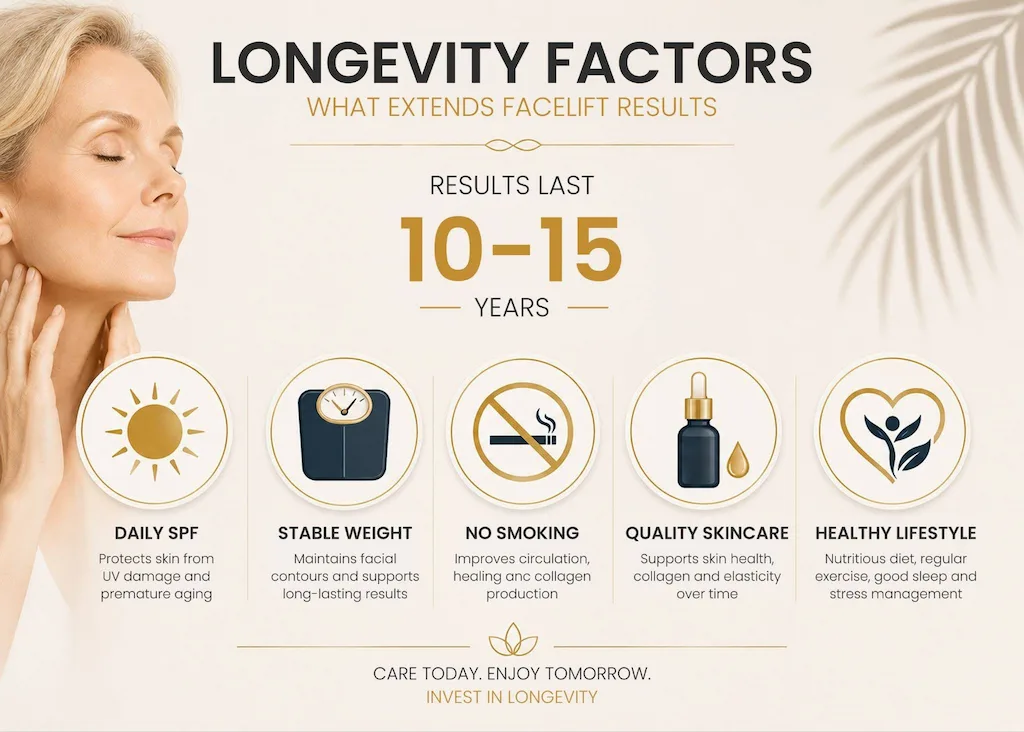
This is the question almost no one asks early enough. Longevity isn’t a single number, but you can plan around realistic ranges. Results can last 10 years or more when paired with a healthy lifestyle, sun protection, and a steady skincare routine.
A few real-world patterns are worth knowing. A mini facelift generally holds for around 5 to 10 years before another conversation about lifting comes up. A traditional SMAS facelift tends to last roughly 10 years. A deep plane facelift often runs the longest, sometimes 10 to 15 years, because the deeper tissue layer was repositioned rather than just tightened. Your face will continue to age normally on top of those results. The lift doesn’t pause the clock, it shifts your starting point.
Three factors move that range up or down more than anything else:
- Skin quality and care. Sun damage, smoking, and inconsistent skincare shorten results. Daily SPF, retinoids, and (for many patients) periodic non-surgical maintenance like neuromodulators or laser resurfacing extend them.
- Weight stability. Big swings in weight, up or down, stress the lifted tissues. Stable weight protects the result.
- Genetics and life stage. Family patterns of facial aging, medications that affect skin (long-term steroids, for example), and major life events with rapid weight change all influence how long results hold.
Teague S.,, a patient at our West Palm Beach office who had a combined face, neck, eyelid, and laser treatment, described the result:
"Dr Sistare performed a face, neck, upper bleph and CO2 laser. I could not be happier with the results! His bed side manner is impeccable, and he is always responsive!! Highly recommend this very skilled professional."
A common follow-up question: how many facelifts can you have over a lifetime? For most people, the honest answer is one major lift, sometimes followed by a smaller revision or a non-surgical refresh ten or more years later. Patients who get good results from a deep plane lift in their 50s often never need another full procedure. To make a plan like that more accessible, our office offers flexible financing through Cherry, CareCredit, and Alphaeon Credit, so you can choose a payment plan that fits your budget.
Are You a Good Candidate, and What Does the Consultation Look Like?
The candidacy question and the consultation question are really one question. There’s no online quiz that can replace an in-person evaluation, and the consultation is where most of the timing question gets answered honestly. Here’s what to expect from both.
The strongest candidates share a few things in common:
- Good general health, with chronic conditions well managed and long-term medications reviewed in advance
- Stable weight for at least the last six months
- Enough skin elasticity to settle smoothly after the lift
- Non-smoker — or willing to stop for at least six weeks before and after surgery (smoking is the single biggest predictor of poor wound healing)
- Realistic expectations: a facelift refreshes the lower face and neck; it doesn't make you look 20 again or change features rooted in bone structure
If you’re not sure where you stand on any of those, that’s exactly what the consultation is for. There’s no expectation to commit at the visit, and no judgment if the answer turns out to be “not yet.”
Your consultation happens in person at our West Palm Beach office, located at 603 Village Blvd, Suite 202, inside the Flagstar Bank building. An in-person visit lets Dr. Sistare perform a thorough, hands-on assessment of your skin quality, tissue mobility, and underlying structure. It’s also your chance to evaluate him: how he answers your questions, how the office feels, and whether the plan matches what you actually want.
The visit usually covers an open conversation about your goals and timeline, a physical evaluation, and a walk-through of the technique options that fit your anatomy. You’ll also leave with a realistic recovery timeline and a discussion of pricing and financing. Nothing is off limits.
Charlotte G., a patient at our West Palm Beach office, described the experience:
"I had a fantastic experience at Dr Michael Sistare's office. From the moment I walked in, the staff was warm and welcoming. Dr. Sistare was incredibly informative and took the time to thoroughly explain every step of the process, which made me feel completely at ease."
When you’re ready to start the conversation, you can schedule your consultation at our West Palm Beach office or call 561-499-9000 to talk through your timing, your goals, and the technique that fits.
Conclusion
You came here turning the timing question over in your head. The honest answer is that the right time is the one your face, your health, and your life actually agree on. That tends to be a quieter signal than a birthday or a milestone, it's the moment the changes have stopped feeling like a passing observation and started feeling like a decision you're ready to take seriously.
When you get there, a good first step is seeing what's actually possible. The facelift photo gallery on our site shows real patient outcomes by procedure type, browsing cases that match your starting point often makes the technique conversation much easier when you're ready for it.
Dr. Sistare and our team in West Palm Beach are here whenever you are. You can start with our contact page or call 561-499-9000 to talk through your timing, your goals, and what comes next.
Frequently Asked Questions
Is 40 too young for a facelift?
Forty is on the early side, but it’s not too young. Many patients in their early to mid-40s are good candidates for a mini facelift if jowls or jawline softening have started and injectables aren’t keeping up. The deciding factor is how much tissue has actually shifted, not the number on your birthday.
What’s the average age for facelift patients?
Most U.S. facelift patients are in their late 50s to late 60s. Per ASPS, 59% of 2024 facelifts were performed on patients ages 55 to 69. The remaining 41% span people in their 30s, 40s, and 70s and older.
How long does a facelift last?
Results can last 10 years or more when paired with a healthy lifestyle, sun protection, and consistent skincare. A mini facelift typically holds for around 5 to 10 years, while deep plane facelifts often run 10 to 15 years because the deeper tissue layer is repositioned rather than just tightened.
Is there a best decade, like the 50s, for a facelift?
The 50s are often called the sweet spot because skin elasticity tends to be good enough for smooth healing, and the changes from aging are usually visible enough to make surgery worthwhile. A facelift in this window also often means you only need one major lift in your lifetime. That said, the right decade is less about averages and more about your specific anatomy.
Can I get a facelift in my 60s or 70s?
Yes, healthy patients in their 60s and 70s can be excellent candidates. The main factor is overall health rather than age, and a deep plane facelift combined with a neck lift is a common combination at this stage. Your surgeon will coordinate medical clearance with your primary care physician as part of the planning.
Mini facelift vs. full facelift: which is right for me?
A mini facelift is designed for early to moderate lower-face changes and uses shorter incisions with a quicker recovery. A full facelift addresses deeper tissue and a larger area, often including the neck, for more dramatic and longer-lasting results. The right choice depends on how much laxity is present and what areas you want addressed.
Does Ozempic face need a facelift?
Rapid weight loss from GLP-1 medications can cause facial volume loss and skin laxity that earlier-decade patients didn’t typically face. For some, fillers or fat grafting are enough to restore volume. For others, a mini or full facelift becomes the right answer once weight has stabilized for several months.
Can fillers delay my facelift?
Sometimes. Fillers can mask early volume loss and softening for a few years, and many patients use them as part of a longer plan that may eventually include surgery. Once underlying tissue has actually descended, though, more filler tends to look heavier rather than lifted, and a facelift becomes the more effective option.
Will I need another facelift later in life?
Most patients have one major facelift, sometimes followed by a smaller revision or a non-surgical refresh ten or more years later. A deep plane facelift in your 50s, paired with steady weight, sun protection, and good skincare, often means a single lift is enough.
Do results look natural if the facelift is done earlier?
Yes, when the technique matches your anatomy. Earlier-stage lifts done with conservative techniques (like a mini facelift in the 40s) often look very natural because there’s less to correct. Deep plane techniques, regardless of age, are designed specifically to avoid the “pulled” look and produce results that read as a refreshed version of you.
Is overall health more important than age?
For surgical candidacy, yes. A healthy 70-year-old with stable medical conditions is often a stronger candidate than a 50-year-old with poorly controlled health issues. At Palm Beach Cosmetic Surgery, your consultation evaluates health, anatomy, and goals together. Flexible financing through Cherry, CareCredit, and Alphaeon Credit is available so cost alone doesn’t decide the timing.
**Disclaimer: The information is intended for educational purposes only and should not be considered medical advice. Every patient's anatomy, health history, and goals are unique, and outcomes, recovery timelines, and candidacy may vary. The only way to determine whether the procedure is right for you is through a one-on-one consultation with a board-certified cosmetic surgeon. Always discuss your specific concerns, risks, and expectations with your provider before making any decisions about surgery. The specialty recognition identified herein has been received from a private organization not affiliated with or recognized by the Florida Board of Medicine."