The Quick answer
Palm Beach Cosmetic Surgery tackles the BBL's scary reputation head-on and explains how much safer the procedure has become. Most side effects like swelling and bruising are mild and temporary, while the rare serious risk, a fat embolism, is tied to improper technique rather than the procedure itself. Modern standards from a 2018 task force, along with real-time ultrasound guidance now required in Florida, have transformed the safety picture, with one 2024 study recording zero fat embolism deaths when surgeons kept fat above the muscle. Since most serious harm happens at high-volume discount clinics, choosing a board-certified surgeon like Dr. Michael Sistare in an accredited facility is the biggest safety decision you can make.
If you've researched a Brazilian butt lift, you've probably seen the headlines. The ones with words like "gone wrong" and "the deadliest cosmetic surgery." That fear can sit quietly in the back of your mind, even when you really want the procedure.
Here's the honest part. The BBL did earn that reputation years ago, and worrying about it doesn't make you dramatic. It makes you careful.
What those headlines leave out is how much the procedure has changed. In 2024, buttock augmentation with fat grafting made up roughly half of all cosmetic surgical procedures in the U.S. South, according to ASPS. The conversation has shifted from spectacle to safety.
At Palm Beach Cosmetic Surgery in West Palm Beach, FL, board-certified cosmetic surgeon* Dr. Michael Sistare believes the best decision is an informed one. This article covers how a BBL works, the real risks, how safety has changed, the recovery rules that protect you, and how to find a surgeon you can trust. Much of your safety comes down to how you find the best plastic surgeons near you.
Key takeaways
- The BBL's scary reputation came from one mistake: fat injected into the muscle. Modern technique keeps fat above the muscle, which has transformed safety.
- Most side effects are mild and temporary. The rare serious risk, a fat embolism, is tied to improper technique, not the procedure itself.
- Recovery protects your health and your results. That means light walking the night of surgery, no direct sitting for up to about six weeks, and a compression garment for roughly six weeks.
- Knowing the warning signs, like sudden shortness of breath or one-sided leg swelling, lets you act fast if something ever feels off.
- Your surgeon is the biggest safety factor. Most serious harm happens at high-volume discount clinics, not with a board-certified surgeon in an accredited facility.
What is a BBL, and how does the procedure work?

A Brazilian butt lift, or BBL, isn't really a lift at all. It's a form of Palm Beach cosmetic surgery for curves that reshapes your buttocks using your own fat.
It happens in two stages during a single surgery. Your surgeon uses Palm Beach body reshaping surgery to remove fat from areas like your abdomen, flanks, or thighs. That fat is purified, leaving only the healthy cells, then injected to add a curve where you want it.
Here's the detail that matters most for safety. The fat goes only in the layer just beneath your skin, never down into the muscle. That single rule, staying above the muscle, is the foundation of everything that makes a modern BBL safer.
So who's actually a good candidate? In general, a BBL tends to suit you if you:
- Are in good overall health and don't smoke
- Are at or near a stable, comfortable weight
- Have enough fat in other areas to transfer
- Have realistic, specific goals for your shape
You may also see the term "liquid BBL." That's a non-surgical option using fillers for subtle volume that fades over time. A surgical BBL uses your own living fat, so the change is more lasting. If that non-surgical route interests you, natural, non-surgical butt lift methods covers what actually works.
Learning the mechanics before you book anything is exactly the right instinct. Understanding how the fat is placed is also the key to understanding the risks.
What are the real risks and complications of a BBL?
Let's start with the reassuring truth. The vast majority of patients recover without any serious problems. Knowing the risks isn't about scaring yourself off. It's about recognizing what a safe surgeon works hard to prevent.
The serious risk, and why it happens
The most serious risk is a pulmonary fat embolism. In plain terms, it can happen if fat is injected too deep, where it enters a large vein and travels to the lungs.
This is the complication behind those headlines, and it's almost entirely tied to one thing: fat placed in the wrong layer. When fat stays above the muscle, that pathway essentially closes. That's why technique matters more than almost anything else here.
The side effects most patients notice
Day to day, the effects most people feel are mild and temporary. Expect some swelling, bruising, and soreness in the donor areas and the buttocks, all normal parts of healing. You may also notice a small pocket of fluid that reabsorbs on its own, or a firmer spot where a little fat settles into a lump.
None of this is pleasant, but it's manageable and expected. Your body also reabsorbs a portion of the transferred fat early on, which is why surgeons slightly overfill to begin with.
You might wonder how a BBL compares to other body procedures. With modern technique, its safety profile is now similar to a tummy tuck, rather than the outlier it once was.
It helps to have a surgeon whose training runs deep. Dr. Sistare is board certified in general surgery in addition to cosmetic surgery, a background that sharpens how he anticipates and manages complications.
Researching this carefully means you'll recognize good care when you see it. If the risks weigh on you, book a consultation to talk through your health and goals first.
How have BBL safety standards changed in recent years?
This is where the story turns hopeful. The BBL of today is not the BBL of ten years ago, and a few specific changes made the difference.
For years, the procedure carried the unwanted title of most dangerous cosmetic surgery, almost always because fat was injected too deep. That pattern is exactly what experts set out to fix.
The 2018 safety turning point
In 2018, a multi-society task force of the world's leading surgery organizations studied these tragedies and issued clear guidance. Their conclusion was simple and firm: fat should never go into the muscle, only into the layer above it.
Out of that work came standards that reshaped the procedure:
- Place fat only above the muscle, never deeper
- Use sturdier, larger instruments that resist dipping too low
- Keep the angle of injection level or upward
- Limit how many of these surgeries one surgeon performs in a day
Staying above the muscle, and seeing it happen
The results have been striking. A 2024 study following more than 12,000 procedures recorded zero deaths from fat embolism when surgeons kept the fat above the muscle.
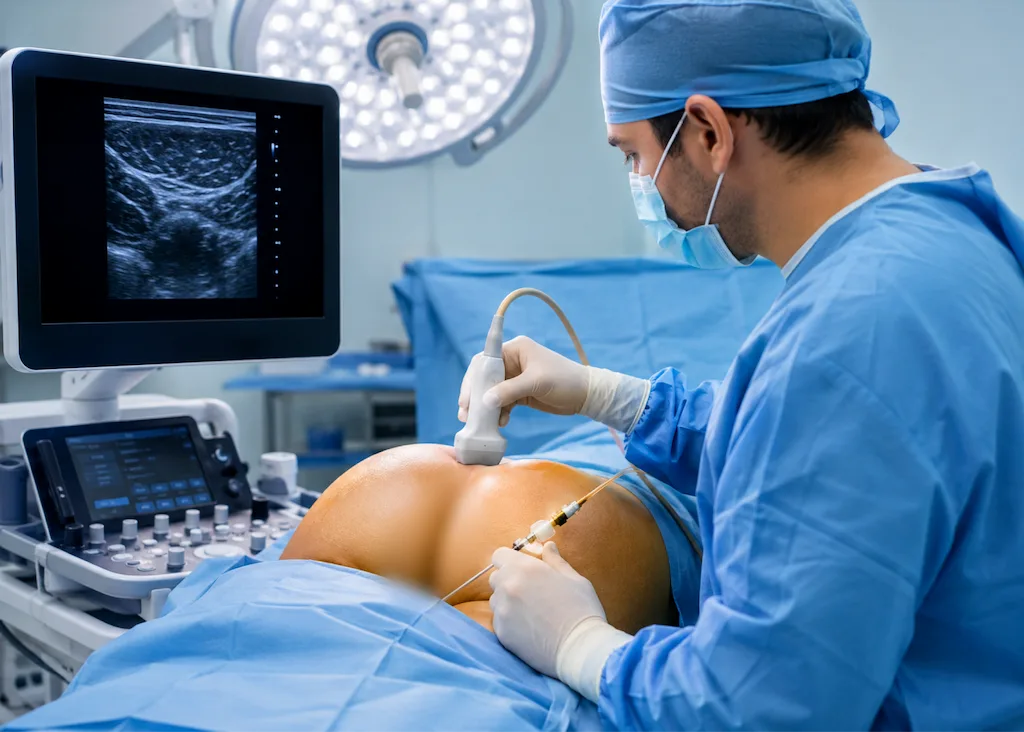
Many surgeons now also use real-time ultrasound during surgery. It lets them watch exactly where the fat goes, confirming it stays in the safe layer instead of relying on feel. Florida is one of the states that now requires this guidance for gluteal fat grafting.
At Palm Beach Cosmetic Surgery, these modern standards are simply how the procedure is done. For some patients, we also offer gluteal auto-augmentation, which reshapes the buttocks using your own repositioned tissue and skips the fat-injection step entirely.
Just ask Charlotte, a patient at our West Palm Beach office who valued a clear explanation of every step:
"Dr. Sistare was incredibly informative and took the time to thoroughly explain every step of the process, which made me feel completely at ease."
When safety is built into the technique and explained clearly, a lot of that early fear eases. The next piece you control is recovery.
What safety measures matter most during BBL recovery?
Safety doesn't end when surgery does. The recovery weeks are where you take the wheel, and a few habits protect both your health and your results.
It actually starts before surgery. Plan to stop smoking at least six weeks beforehand, since nicotine starves healing tissue of oxygen. Avoid aspirin and other anti-inflammatory pain relievers for at least two weeks before your date.
Protecting your results with no direct sitting
The transferred fat needs time to build a new blood supply, and direct pressure can cut that off. So you'll avoid sitting directly on your buttocks during the early weeks, generally up to about six weeks. A special cushion, sometimes called a BBL pillow, shifts your weight to your thighs when you need to sit.
Compression, walking, and pain
A compression garment controls swelling and supports the treated areas. Plan to wear it for about six weeks, not just the first few days.
Movement matters more than rest early on. Light walking should start the very night of your surgery, which keeps circulation moving and lowers the risk of blood clots. Most patients need prescription pain medicine for only about three days, and many return to work within one to three weeks.
You can usually drive again within a few days, once you're off the stronger pain medicine. The small incisions close with dissolvable sutures, so nothing needs to be removed later.
Warning signs that deserve immediate attention
Serious problems are uncommon, but knowing the warning signs keeps you safe. Seek emergency care right away for sudden shortness of breath, chest pain, a racing heartbeat, severe dizziness, or swelling and pain in one leg. A high fever or spreading redness around an incision also deserves a prompt call.
These moments are rare, and being prepared is part of being an informed patient. Clear aftercare is a big reason recovery feels less daunting with the right team, where detailed instructions and a familiar face are a phone call away.
How do you find a safe surgeon and avoid a buttock augmentation gone wrong?
If one decision shapes your safety more than any other, this is it. Almost every story of a buttock augmentation gone wrong traces back to the same root cause: the wrong surgeon, in the wrong setting.
Most of the tragedies you've read about didn't happen at established practices. Research into BBL deaths in South Florida found the vast majority occurred at high-volume discount clinics. These are the ones that move patients through assembly-line style on rock-bottom prices.
Here's the important distinction. Affordable care and unsafe care are not the same thing. The danger isn't a fair price. It's a clinic that cuts corners on credentials, the facility, the technique, and the time each patient deserves.
Wanting a procedure you can actually afford is reasonable. So is refusing to gamble on safety to get there. You can hold both. To keep safe, qualified care within reach, view financing options through Cherry, CareCredit, and Alphaeon Credit.
Questions worth asking before you book
A safe surgeon and a safe setting share a few non-negotiable traits. Before you book anything, ask direct questions:
- Are you board certified in cosmetic or plastic surgery?
- Do you inject fat only above the muscle, never into it?
- Do you use real-time ultrasound guidance during the procedure?
- Is the surgery performed in an accredited surgical facility?
- How many of these procedures do you perform in a single day?
A confident, qualified surgeon welcomes every one of these questions. This is the standard Dr. Sistare holds. He's recognized as a specialist by the American Board of Cosmetic Surgery and board certified* in general surgery by the American Osteopathic Board of Surgery. As a single-surgeon practice, your procedure is never one of seven crammed into a long, rushed day.
A thorough, in-person consultation is your best screening tool, and it goes both ways. It's your chance to evaluate the surgeon as much as theirs to evaluate you. You should leave feeling heard, not hurried.
Consider Alexandra, a patient at our West Palm Beach office who weighed her options carefully:
"He listened carefully to what I wanted and explained step by step how and what to expect from the procedure. He took his time to answer ALL of my questions. I didn't feel persuaded to change my mind about what I wanted."
That feeling, being listened to instead of sold to, is one of the clearest signs you're in the right place.
Conclusion
Those headlines that worried you at the start? They're real, but they tell an old story. The modern BBL, done by the right surgeon in the right way, is a far cry from the procedure that earned its reputation.
When you're ready to picture what's possible, browsing real before-and-after photos is a grounding next step, and a personal consultation fills in what a photo can't.
Safety, honesty, and care you can actually afford are the heart of how Dr. Sistare practices in West Palm Beach. When you feel ready, schedule your personal consultation or call 561-462-4469 to start your journey to confidence on solid footing.
Frequently asked questions
What does it mean when a buttock augmentation goes wrong?
A buttock augmentation gone wrong usually means either an aesthetic issue, like asymmetry or firm lumps, or a serious medical event from fat placed too deep. The most dangerous outcomes are strongly linked to unqualified providers and discount clinics, not to the procedure when it's done correctly.
What are the most common BBL side effects?
Most side effects are mild and part of normal healing. Expect temporary swelling, bruising, and soreness in both the buttocks and the areas where fat was removed. Some firmness or a small fluid pocket can also appear early and usually settles on its own.
Is a Brazilian butt lift safe compared to a tummy tuck?
They're closer than you'd expect today. With fat placed only above the muscle, a modern BBL carries a safety profile comparable to a tummy tuck. A decade ago, that comparison wouldn't have been possible.
How does ultrasound guidance make a BBL safer?
Ultrasound lets your surgeon see exactly where the fat is going in real time. Instead of relying on feel, they can confirm the fat stays in the safe layer above the muscle. It's one of the biggest reasons the procedure is safer now, and Florida requires it for these surgeries.
What are the warning signs of a BBL complication?
Knowing these gives you peace of mind, not anxiety. Seek emergency care for sudden shortness of breath, chest pain, a racing heartbeat, or severe swelling and pain in one leg. A high fever or spreading redness at an incision also warrants a quick call to your surgeon.
*Disclaimer: The specialty recognition identified herein has been received from a private organization not affiliated with or recognized by the Florida Board of Medicine. This content is for educational purposes only and does not constitute medical advice. A consultation with a qualified board-certified surgeon is required to determine the best treatment plan for your individual needs and any questions you may have about a medical condition or procedure.