You've picked your date. The surgery itself is only a few hours, which means the part that actually requires the most from you is everything that comes after. You've already done the research. You're comfortable with the why.
Now you want to know what it's really like on the other side. That's what this article is for. Recovery is where your result actually takes shape, and where small, unglamorous daily choices, how you sleep, what you eat, when you rest, quietly move you back toward looking like yourself.
If you're reading this, you're probably not just curious. You're planning. And you're not alone in that. ISAPS tracked over 470,000 neck lift procedures worldwide in 2024, making it one of the most commonly performed cosmetic surgeries globally. That's a lot of people navigating the exact same recovery window you're about to walk through.
At Palm Beach Cosmetic Surgery in West Palm Beach, FL, we know the recovery timeline is often the thing that tips the decision. Not the procedure itself, but what life looks like in the days and weeks after. This article walks through what really happens, hour by hour and week by week: what helps healing along, what to expect when, and which warning signs are worth a phone call.
Key takeaways
A quick map of what's ahead, so you can scan now and come back for the details.
- The first 24 to 48 hours focus on rest and head elevation, with pressure-like tightness rather than sharp pain for most patients.
- Swelling and bruising usually peak around days three to five, then ease noticeably by the end of week one.
- Many people return to desk work within about three days, once they're off prescription pain medication, even while some bruising is still fading.
- Weeks two through six bring steady invisible progress, with most activity restrictions lifting by the end of week six.
- Final results usually settle between three and six months, and the healthiest recoveries come from elevation, protein, hydration, and strict sun protection.
What happens immediately after neck lift surgery?

The first 24 to 48 hours are quiet, deliberately so. You'll wake up in a recovery area with a light compressive headwrap around your neck and jaw, which Dr. Sistare removes the next day at the office. A thin drain may also be placed to catch excess fluid and help prevent pockets that could slow healing.
The pain level on day one tends to surprise people. It feels more like firm pressure than a sharp, throbbing hurt. Most patients don't need prescription pain medication past about three days, and many step down to over-the-counter options sooner than they expected.
Keeping your head elevated is the single most important thing you can do in this window. Dr. Sistare recommends a mild elevation of about 15 degrees, on pillows or in a recliner, to help fluid drain away from the surgical area. That one habit can cut days off how long bruising and puffiness stick around.
Certain activities are off limits right away. No bending at the waist, no heavy lifting, no vigorous neck movement, no hot showers, no nicotine, no alcohol. Gentle walking around the house is encouraged starting the evening of surgery, because light movement keeps circulation up.
Dr. Sistare follows up with neck lift patients, often with a check-in call that same evening or the next morning. It's a small thing, but patients mention it again and again in their reviews, and it makes sense: no one should be lying in a recliner at 10 p.m. wondering whether what they're feeling is normal.
Sharon G., a patient at the West Palm Beach office who had neck and facial surgery, described exactly that experience:
"Dr. Michael Sistare did surgery for my neck & face and I was very pleased with his expertise during my surgery. He called me later that night after the surgery to check up on me. That was very impressive. The post-opt experience was very good."
That call doesn't change the medicine, but it changes how the first 48 hours feel, and on the off chance something doesn't feel right, it gives you the opportunity to ask about it. After the next-day visit to remove your headwrap, your first full follow-up usually falls within five to seven days. Dr. Sistare uses dissolvable sutures, so there's nothing to take out, and any drain is removed at this visit. If you're still weighing whether a neck lift is right for you, schedule a consultation to talk through what your specific timeline would look like.
What is the first week of neck lift recovery like?
Week one is where recovery feels most intense and where visible progress begins at the same time. Swelling and bruising peak between days three and five, then start to soften. Jaw tightness eases noticeably by the end of the week.
Any drain usually comes out between days five and seven at the first full follow-up. That appointment tends to be a morale boost. Because the sutures are dissolvable, there's nothing to remove, the drain slides out in seconds, and the neck feels less constricted.
The need for pain medication drops quickly after day three. Acetaminophen handles most residual discomfort by the end of the first week. Sleep still stays elevated, but daytime activity can expand to reading, streaming, short walks, and brief phone calls.
Washing is the question most people are afraid to ask. You can usually shower from the shoulders down the day after surgery. Most surgeons allow gentle hair washing around day three to five, depending on incision placement. A handheld showerhead and an extra pair of hands make the first wash easier.
Incision care is straightforward once dressings come off. Keep the area clean and dry, pat rather than rub, apply any prescribed ointment thinly, and avoid sun on the incisions for at least three months. The thin lines along the back of the ear and under the chin fade as they heal.
Warning signs exist, and knowing them matters more than obsessing over them. Call your surgeon if you notice any of these:
- Sudden, one-sided swelling that looks different from the other side
- Fever over 101 degrees or worsening redness around an incision
- Drainage that smells unusual or turns yellow or green
- Sharp, increasing pain that doesn't respond to your medication
- Numbness that suddenly gets worse, or new visible asymmetry
Most first weeks are uneventful. The list above is the safety net, not the expectation.
When can you return to work and daily life after a neck lift?
Most patients can step back into desk or computer work within about three days, as soon as they're off prescription pain medication. Bruising may still be fading at that point, so patients in public-facing or on-camera roles often choose to wait a little longer; Zoom calls feel manageable with a softer angle and good lighting.
Being seen in public is subjective, but most patients feel ready for low pressure outings like a coffee run by the end of week two. Makeup can cover residual yellow green bruising well from about day ten onward. Green tinted color correctors with a medium coverage foundation do most of the work.
Compression is simpler here than at many practices. After the headwrap comes off the next day, Dr. Sistare doesn't require any ongoing compression. Some patients choose to wear a soft chin strap for comfort, but it's optional rather than part of the protocol, and most people who do stop noticing it within a few days.
Once you're off prescription pain medication and can turn your head comfortably from side to side, you can drive again. Since most patients are off those medications within a few days, driving often resumes early in the first week, though comfortable head-turning can take a little longer. If you can't do a safe shoulder check, it's not time yet, even if you feel fine sitting still.
Physical jobs add a layer of planning. If your work involves lifting over 10 pounds or prolonged neck flexion, most surgeons ask for two to three weeks of lighter duty. Ask about staged returns, short shifts or remote days, before jumping back to full hours.
How does neck lift healing progress in weeks two to six?
Weeks two through six are the quiet middle of recovery. Nothing dramatic happens on any single day. But if you take a photo each Sunday and compare them, the progress is easier to see.
Swelling drops steadily after week two. By week three, many patients say the neck feels more flexible and the jawline looks more defined. Residual puffiness tends to concentrate under the chin and can linger into month two.
Light exercise typically becomes possible around weeks two to three. Walking, stationary biking at a gentle pace, and low impact stretching are common approvals. Anything that raises heart rate significantly, like weightlifting and running, usually waits until week four to six. Heat based activity, hot yoga, saunas, and hot tubs, typically need to wait until week six at minimum.
| Week | Typical progress | Activities usually okay | Activities usually still to avoid |
|---|---|---|---|
| 2 | Most bruising fades; mild swelling persists | Desk work, driving, social outings | Heavy lifting, vigorous cardio |
| 3 | Jawline definition starts showing | Walking, stationary bike, stretching | Contact sports, saunas |
| 4 | Tightness eases; numbness fades gradually | Gentle exercise, easy travel | Heavy strength training |
| 5-6 | Swelling mostly resolved; contour close to final | Return to most workouts with clearance | High impact activity without sign-off |
Scars need attention in this window, not worry. Keep them out of direct sun and start a medical grade silicone gel or sheet around week three to four. The redness fades from pink to pale over the next several months. Incisions behind the ear and under the chin sit where hair and natural shadows hide them well.
Numbness and tightness are the sensations that surprise people most. Parts of the neck and jawline may feel less sensitive for weeks. That's the nerves settling after surgery, not a complication, and sensation usually returns over the following months.
Bending at the waist and sleeping on your stomach should still be minimized through week four. After that, restrictions loosen section by section as your surgeon clears you. Browse our photo gallery to see how the contour settles during these in-between weeks.
What happens during long term neck lift recovery?
By month three, most patients feel back to themselves, even if every bit of healing isn't technically complete. The jawline looks refined, the neck contour reads naturally, and the concerns that started this whole process are clearly resolved. Final results, the version you'll see in photos years from now, usually settle between three and six months.
Scar fading continues quietly for another six to twelve months. Pale pink lines turn into faint silver threads that blend with normal skin tones. Your surgeon will recommend sunscreen on any visible incision for a full year, because UV exposure can darken healing scars. Silicone gel or scar sheets, used nightly for six months, are a small investment that pays off.
Sensation continues to return during this phase. The patches of numbness that felt strange at week three soften and integrate. Some patients report a lingering area near the ear or under the chin that stays slightly less sensitive, but it rarely interferes with daily life.
Maintaining your results long term is mostly about basics. Sun protection, a stable weight, good hydration, and not smoking are the big four. A neck lift doesn't slow future aging, it sets back the clock, and from there you tend your skin the way you would a garden.
What if swelling lingers past three months?
Call your surgeon. Minor puffiness can persist into month four or five, especially for patients with thicker skin. True persistent swelling is uncommon enough to warrant a quick in-person check.
Neck lift results can last 10 to 15 years, depending on age at surgery, skin quality, and lifestyle habits. Patients who protect their skin and stay at a steady weight tend to sit at the upper end of that range. The neck at year 10 still tends to look years younger than it would have without the procedure.
When patients look back on the experience as a whole, not just the results, but the process of getting there, the relationship with the surgical team is often what they remember most.
Deborah C., a patient who had a neck lift with Dr. Sistare, put it this way:
"I am above and beyond happy with the smartlift facial surgery and necklift surgery I recently had done. After seeing many of his patients' results, I decided to have my surgery done by Dr. Sistare. Throughout the whole journey, he and his fabulous staff were and are amazing."
That word, journey, comes up a lot when patients describe the arc from consultation through long term results. An annual check-in isn't required, but many patients appreciate one. And if you want to see how long term outcomes actually settle, browsing real patient photos is a good place to start. Request an appointment to talk through what fits your goals.
What tips can speed up neck lift recovery?
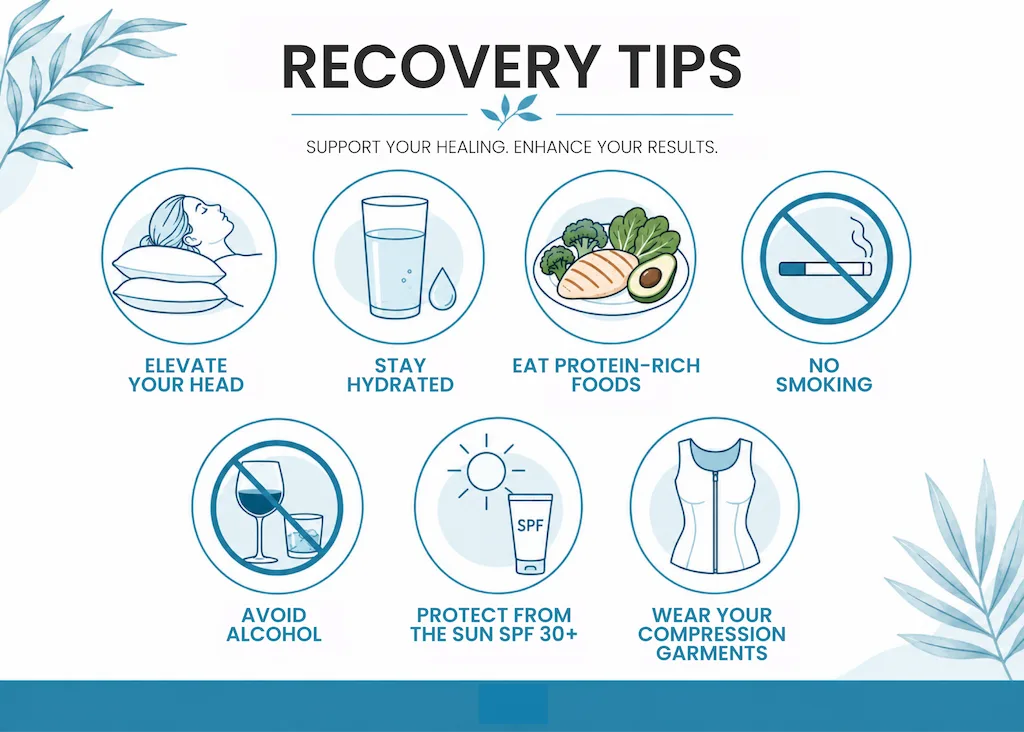
Healing faster isn't about shortcuts. It's about consistently doing the unglamorous small things that swelling, circulation, and tissue all respond to. The fastest recoveries come from patients who nail the basics and don't improvise.
Elevation instead of ice
Keep your head higher than your heart for the first two weeks, especially while sleeping. A wedge pillow, a recliner, or two to three stacked pillows all work. Gravity handles much of the early fluid management your body can't do alone.
Cold compresses are one of the few areas where practice protocols vary. Some surgeons permit brief cold application, but Dr. Sistare specifically advises against ice packs on a healing neck and recommends relying on head elevation instead.
Hydration and protein
Your body needs building blocks to close incisions and rebuild supporting tissue. Aim for eight glasses of water a day and protein at every meal. Citrus and berries add Vitamin C, which supports collagen production during healing.
Salt is the opposite of helpful in the first two weeks. High sodium foods pull fluid into tissue and slow the de-swelling process. Processed foods and takeout should take a back seat to simple, nutritious, home cooked options.
Skip nicotine, pause alcohol
Smoking, vaping, and chewing tobacco starve healing tissue of oxygen. Most surgeons require a nicotine free window of four to six weeks before and after surgery. Nicotine raises the risk of delayed healing, wound separation, and visible scarring.
Alcohol is a milder but similar story. It thins the blood, interferes with pain medication, and increases swelling. Most surgeons ask patients to hold off for at least two weeks post-op.
Compression and sleep position
Dr. Sistare keeps compression simple: a headwrap for the first day, then nothing required afterward. If you do choose to wear a chin strap for comfort, the practice doesn't charge for the garments. Either way, the bigger variable in how your contour settles is protecting the area and following the plan you're given.
Sleeping on your back with your head elevated helps maintain the drainage angle during the early weeks. Avoid positions that pull at the incisions or add pressure to one side of the neck, and avoid sleeping on your stomach until well past week four. A small travel pillow on either side of the head makes back sleeping easier if you're normally a side sleeper.
Long term caution
Sun exposure is the biggest long term threat to scars and skin quality. Avoid direct sun on the neck for three months, then use a broad spectrum SPF 30 or higher any time you're outside during the first year. Saunas, hot yoga, and long hot showers increase swelling and should wait until week six at minimum.
Follow the plan your surgeon gives you at your consultation, not the average of what you find in forums. Every technique, skin type, and health history is different.
Conclusion
You came into this article with a date on the calendar and a head full of questions. Now you have an idea of what to expect: quiet early days, a turning point in week one, and a practical return to desk work within a few days of surgery. Then a long, steady middle where the results quietly come into focus, and a point somewhere around month three where the new jawline stops feeling new and just becomes the way you look.
If you're still picturing what that arc actually looks like, browsing real patient before-and-after photos can help more than any timeline on a page. Seeing someone else's day one next to their month three is often what makes the whole thing feel real, and reachable. A personal consultation fills in the rest: the details that photos can't show, like what your specific anatomy and health history mean for your recovery.
Dr. Sistare and the team at Palm Beach Cosmetic Surgery take pride in a recovery process that feels like someone's actually in your corner, not just a folder of post-op instructions and a "call us if something goes wrong." Reach out to our office or call (561) 462-4469. The conversation is where it starts, and you already know more than you think.
Frequently asked questions
How painful is neck lift recovery?
Pain after a neck lift is usually described as pressure or tightness rather than sharp hurt. Most patients don't need prescription pain medication past about three days and switch to over-the-counter options after that. Dr. Sistare advises against ice packs on a healing neck and relies on head elevation instead.
How long does swelling last after a neck lift?
The most visible swelling peaks around days three to five, then eases significantly by week two. By week four to six, only mild residual puffiness usually remains, most often under the chin. Full resolution of all swelling can take three to six months.
When can I return to work after a neck lift?
Most patients return to desk or computer work within about three days, as soon as they're off prescription pain medication. Physical jobs that involve lifting or prolonged neck flexion usually require two to three weeks of lighter duty. Dr. Sistare will clear you based on the extent of your specific procedure.
When can I exercise after a neck lift?
Gentle walking is encouraged from the evening of surgery to support circulation. Light exercise like stationary biking and stretching can resume around weeks two to three. Weightlifting and running typically wait until weeks four to six with surgeon clearance, while hot yoga and other heat-based activity wait until week six at minimum.
Will I have visible scars from a neck lift?
Incisions are carefully placed behind the ears, along the hairline, and sometimes under the chin, where natural shadows and hair provide camouflage. Scars start out pink, then fade to pale lines over six to twelve months. Sun protection, silicone gel, and following your surgeon's scar care plan produce the best long term outcomes.
Is numbness permanent after a neck lift?
Numbness around the ears, jaw, and upper neck is normal for the first few weeks and usually resolves gradually over the following months. A small patch may remain slightly less sensitive long term in some patients, but it rarely affects daily life. Let your surgeon know if numbness worsens rather than improves.
How long until I see final neck lift results?
Most patients see the shape of their final results by three months, when residual swelling has resolved. Scars continue to fade for another six to twelve months. Your surgeon will walk through realistic timeline expectations during the consultation so there are no surprises.
Does smoking affect neck lift recovery?
Yes, significantly. Nicotine constricts blood vessels and starves healing tissue of oxygen, which raises the risk of delayed healing and more visible scarring. Most surgeons require patients to be nicotine free for four to six weeks before and after surgery.
Can I drive after neck lift surgery?
Driving is usually safe once you're off prescription pain medication, often within the first several days, as long as you can turn your head for shoulder checks. If a safe shoulder check isn't possible yet, hold off a few more days, even if you feel fine sitting still.
What foods help neck lift healing?
Lean protein at every meal, plenty of water, and produce high in Vitamin C support collagen production and tissue repair. Keep sodium low for the first two weeks to minimize swelling. Flexible financing options are available if planning around time off work would help.
**Disclaimer: The information is intended for educational purposes only and should not be considered medical advice. Every patient's anatomy, health history, and goals are unique, and outcomes, recovery timelines, and candidacy may vary. The only way to determine whether the procedure is right for you is through a one-on-one consultation with a board-certified cosmetic surgeon. Always discuss your specific concerns, risks, and expectations with your provider before making any decisions about surgery. The specialty recognition identified herein has been received from a private organization not affiliated with or recognized by the Florida Board of Medicine."