You've started catching it in photos. The eyes that used to look bright now read as tired, even on the mornings you slept well. Maybe it's the heaviness pressing on your lashes when you put on eyeliner, or the way your forehead works overtime just to keep your field of view clear. None of it is dramatic. It just adds up, little by little, until you find yourself wondering whether something can be done.
You're not the only one wondering. According to ISAPS, more than 2.1 million eyelid surgeries were performed globally in 2024, making it the number one face and head procedure worldwide. Upper blepharoplasty, often shortened to "upper bleph," is the version that targets the upper lids specifically, lifting heavy skin so the eye area looks lighter and more open.
At Palm Beach Cosmetic Surgery in West Palm Beach, FL, board-certified cosmetic surgeon* Dr. Michael Sistare helps patients across South Florida understand what upper blepharoplasty can and can't do for them. This article walks through candidacy, the procedure itself, what day-by-day recovery looks like, the kind of results to expect, and the risks worth knowing. By the end, you should have a clearer sense of whether this is the right step right now. It's the kind of candid guidance you'd want when weighing Palm Beach cosmetic surgeon options.
Key takeaways
- Upper blepharoplasty removes excess skin (and sometimes a small amount of fat or muscle) from the upper eyelids, opening up the eye area and, in some cases, restoring lost peripheral vision.
- The best candidates have heavy or droopy upper lids, are in generally good health, and have realistic expectations. Conditions like glaucoma, severe dry eye, thyroid disease, and uncontrolled blood pressure may rule the procedure out.
- The surgery itself usually takes about an hour, is done as an outpatient procedure under local anesthesia with sedation, and uses incisions hidden in the natural fold of the upper eyelid.
- Most patients return to desk work and daily routines within one to two weeks. Final swelling resolves over a few months, and the scar typically fades to nearly imperceptible.
- Results commonly last 5 to 7 years or longer. Risks are low when the procedure is performed by an experienced surgeon, and any concerns should be raised during a thorough consultation.
Am I a good candidate for upper blepharoplasty?
The clearest sign that upper blepharoplasty might help is when the skin of your upper lids has started to droop enough to change how your eyes look, feel, or function. Patients describe it in different ways. Some say they look perpetually tired. Others mention having to lift their eyebrows to read or drive. A few describe the loss of a real eyelid platform for shadow or liner. All of it is normal, and all of it is a reasonable reason to ask whether surgery is the right fit.
For heavy, hooded lids specifically, hooded eyelid repair is exactly what the procedure is designed to correct.
You may be a good candidate if you notice:
- Heavy or droopy upper eyelid skin that rests on your lashes or crowds your eye crease
- A heavier, tired-looking appearance that doesn't match how rested you actually feel
- Obstructed peripheral vision caused by the upper eyelid hanging into your line of sight
- Forehead fatigue from constantly lifting your brows to compensate for heavy lids
Most patients who pursue upper blepharoplasty are over 35, with the majority falling between the ages of 40 and 70. Younger patients with congenital concerns occasionally benefit too. What matters more than your birthday is whether the anatomy of your eyelids matches what the procedure is designed to correct.
Certain medical conditions can complicate eyelid surgery and may rule it out for now. Glaucoma, severe dry eye syndrome, diabetes, thyroid disorders, and uncontrolled high blood pressure are the ones your surgeon will ask about most carefully. Smokers are also asked to quit before surgery, since smoking slows healing and raises the risk of small complications.
It's worth knowing that not every concern around the eyes is something blepharoplasty can fix. Crow's feet, fine lines, and dark circles sit just outside its lane. If those are your main issues, an honest consultation will usually point you toward wrinkle treatment injections, injectable fillers, or skin treatments rather than surgery. A skilled surgeon will tell you when to wait or when a non-surgical option will get you closer to what you actually want. Dr. Sistare evaluates each patient's eyelid anatomy, brow position, tear film, and overall health before recommending a path, and he'll say so plainly if surgery isn't the right call yet.
Researching carefully before committing to a procedure this personal is exactly the right approach. If you're trying to understand where you stand, a personal consultation at our West Palm Beach office is the most direct way to get a real answer.
How is the upper blepharoplasty procedure performed?
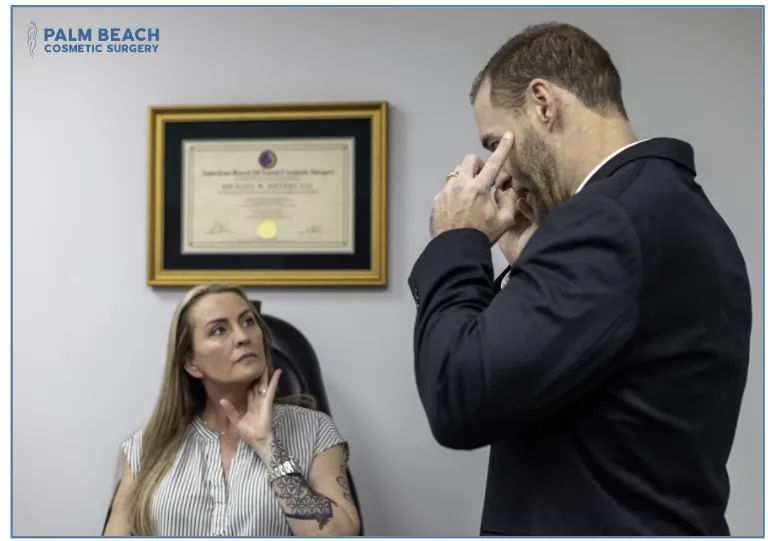
Upper blepharoplasty is a precise, relatively short surgery. The basic goal is to remove the excess skin (and sometimes a small slice of muscle or fat) that's making the upper lid feel heavy, while keeping the natural shape of your eye intact. Most procedures take about an hour and are performed in an outpatient setting, meaning you go home the same day with a pre-arranged driver.
Anesthesia and setting
Upper eyelid surgery is performed under local anesthesia with sedation. Because the work is confined to the upper lids, there's no need for general anesthesia. You'll be comfortable and won't feel pain throughout. The surgery is performed in an accredited outpatient surgical facility, and patients typically spend a short time in a recovery suite before heading home.
Incision placement
This is the question most people ask first, and the answer is reassuring. The incision sits within the natural crease of your upper eyelid, around 8 to 10 millimeters above the lash line. Once everything heals, the scar essentially disappears into the line that's already there when you open and close your eye. After healing, most patients struggle to find the scar at all.
What's actually removed
Through that small incision, your surgeon removes a strip of redundant skin from the upper lid. In some cases, a thin sliver of the underlying muscle (the orbicularis) is also removed for a smoother contour. A conservative amount of fat from the upper compartment may be repositioned or removed, but contemporary technique leans toward preserving fat to keep the upper lid looking soft rather than hollow. Once skin (and any muscle or fat) is removed, the incision is closed in fine layers with dissolvable sutures that absorb on their own, with no removal needed.
Combining with other procedures
Upper blepharoplasty is one of the most "stackable" facial procedures. It pairs naturally with procedures that smooth forehead lines and lift the brows when sagging brows are part of the problem. A facelift or neck lift works well when patients want a fuller facial refresh. A lower blepharoplasty addresses puffiness or hollowness beneath the eyes. Whether to combine is a personal choice based on goals, budget, and how much downtime you can take in one stretch.
What does recovery look like after upper eyelid surgery?
Recovery from upper blepharoplasty is generally easier than people expect. Most of the real downtime falls into the first one to two weeks, with the bulk of swelling resolving on a predictable timeline. You'll likely feel a little tight and puffy in the first few days, but actual pain is usually mild and well-controlled with over-the-counter medication. The bigger task is patience, since the final shape settles in slowly as residual swelling fades.
| Phase | What to expect |
|---|---|
| Days 1 to 3 | Peak swelling and bruising. Apply a warm compress for 20 minutes, then a cool compress for 20 minutes, repeating the cycle every 2 hours, and keep your head slightly elevated while sleeping. |
| Days 4 to 7 | Bruising shifts color and starts to fade. Dissolvable sutures absorb on their own, with no removal needed. |
| Week 2 | Most desk-job patients return to work. Bruising covers easily with makeup once incisions are healed. |
| Weeks 3 to 4 | Light exercise resumes. Eyes look noticeably more rested. |
| Months 3 to 6 | Lingering puffiness fully resolves. Final shape and scar appearance settle in. |
A few specific guidelines almost always apply. Skip makeup and contact lenses for about two weeks. Sleep with your head elevated on a couple of pillows for the first few nights. Avoid heavy lifting, bending forward, and strenuous exercise for two to three weeks. Most patients return to non-physical work within seven to ten days, and to fully public-facing roles within two weeks. Sun protection (tinted sunglasses help a lot here) is one of the most underrated parts of recovery, since freshly healing skin pigments more easily in bright light.
What sets recovery apart, more than any of the timelines, is the quality of follow-up care. At Palm Beach Cosmetic Surgery, post-operative attention isn't an afterthought, it's part of the surgery itself. Your surgeon provides detailed instructions and sees you for in-office follow-up visits. Patients regularly mention being given a direct phone number so they can reach the team with questions instead of routing through a call center.

Victoria, a patient at our West Palm Beach office who had her upper eyelids addressed after years of vision impact, described her recovery experience:
"After years of dealing with my eyelids impacting my vision, I finally decided to move forward with a procedure to address it and I'm so glad I chose Dr. Sistare. From the first appointment, he was thoughtful, clear, and attentive. He took the time to explain everything, answer my questions, and made sure I felt comfortable throughout the process. The procedure itself was awake, smooth and surprisingly easy. I'm very grateful for Dr. Sistare's expertise and care, and I wouldn't hesitate to recommend him to others considering similar care! He has great bedside manner, and also gives you his personal number to help answer any questions."
Cost is a fair concern alongside recovery time. Upper eyelid surgery is one of the more accessible cosmetic procedures by price. To help your timeline fit your budget instead of the other way around, view financing options through Cherry, CareCredit, and Alphaeon Credit.
What results can I expect from upper blepharoplasty?

The visible change after upper blepharoplasty is rarely dramatic in the "operated" sense. It's more like the version of your face on a well-rested morning, only consistent. The heaviness lifts. The crease above your lashes becomes a defined line again. Your eyes look a little more open, a little brighter, and the part of your forehead that was working overtime to lift droopy lids finally gets to relax.
Several things shape the timing of those results:
- Initial improvement is visible within the first week or so as early swelling eases.
- The first major reveal happens between two and six weeks, when most surface swelling has resolved.
- The final shape and scar quality settle in over three to six months.
- Patient satisfaction with upper blepharoplasty consistently runs above 90 percent in published outcome studies measuring quality of life and appearance.
Most patients enjoy their results for roughly 5 to 7 years or longer. The surgery doesn't pause aging, so the skin around your eyes will continue to change gradually over time. Many people never need a follow-up procedure. Some choose a small touch-up many years later. Revision rates are low overall, and when they happen, they're usually for minor asymmetry or residual skin rather than anything significant.
A common worry is the scar. Because the incision sits inside the natural eyelid crease, most patients have a hard time spotting it even at close range. Aftercare matters here, and your surgeon should walk you through how to support healing during the first few months.
For patients whose upper lids genuinely obstructed peripheral vision, the functional payoff often surprises them. Dr. Sistare's approach to results favors balance and naturalness over dramatic change. The goal is for friends to ask if you've been sleeping better or just got back from vacation. They shouldn't be asking what you "had done." To see what real outcomes look like, browse our eyelid surgery photo gallery of before-and-after images from actual patients.
What are the risks and complications of upper eyelid surgery?
Upper blepharoplasty is one of the safer cosmetic procedures, but no surgery is without potential complications. Honest information about what can happen, how often, and how to lower your risk is the foundation of a real decision. Most issues are minor and resolve on their own.
Common, generally short-lived effects include:
- Mild bruising and swelling around the eyes, peaking days two to three and resolving over one to two weeks
- Temporary dry, gritty, or watery eyes as the eyelid muscles settle
- Brief light sensitivity in the first week or two
- Numbness or odd sensation along the incision line as nerves heal
- A short stretch of mildly blurred vision from ointments or initial swelling
Rarer but more serious issues are worth knowing about. These include orbital hemorrhage (roughly 1 in 2,000 cases in published series), permanent vision changes (around 1 in 10,000), eyelid asymmetry, or temporary difficulty fully closing the eyes. They happen infrequently in healthy, well-selected patients. Surgeons screen carefully for the conditions that raise these risks during the consultation.
You can lower your own risk before surgery by:
- Quitting smoking at least 6 weeks before surgery (nonsmokers have around 44 percent fewer complications)
- Pausing aspirin, ibuprofen, and other blood-thinning medications and supplements per your surgeon's instructions (typically 2 weeks before)
- Disclosing every medication and supplement you take, including herbal ones
- Choosing a surgeon whose training, board certification, and outcomes you've actually verified
After surgery, call your surgeon promptly if you notice any of the following:
- Sudden severe pain that medication doesn't touch
- Rapid swelling that worsens after the first few days
- Vision changes
- Heavy bleeding
- Fever
- Unusual discharge from the incisions
None of these are common, but they're the moments where reaching your surgical team quickly matters most.
Healing is generally on track when swelling peaks by day three and drops sharply by the end of week two. The dissolvable sutures absorb on their own, with no removal needed. Bruising fades over two to three weeks, and the final shape settles in over a few months. If something feels off, a quick call usually clears it up. Surgeons would always rather hear from you than have you sit with worry.
Joe, a patient who emphasized careful pre-surgical evaluation, shared his impression:
"Dr. Sistare is an outstanding plastic surgeon who embodies honesty and professionalism. His candid approach during consultations, coupled with his meticulous attention to detail and commitment to patient safety, sets him apart in the field. Dr. Sistare's exceptional surgical skills and genuine care for his patients have been instrumental in achieving the outstanding results I was hoping for."
If you're unhappy with a result, the standard recommendation is to wait six months before considering revision. Healing takes time, and what looks asymmetric at three months often looks balanced at six. Most patients don't end up needing one.
Conclusion
You started this article because something about your reflection didn't match how you felt inside. Tired eyes, heavy lids, a forehead that worked too hard, or maybe just the slow sense that the eye area was reading older than the rest of you. Whatever the specific trigger, the questions you're sitting with, whether the change is worth it, whether the procedure is safe, whether the result will look natural, are exactly the right ones to be asking.
A good next step, when you're ready, is to look at real before-and-after photos so you can see what these results actually look like on real patients. From there, an in-person consultation gives you a direct, honest answer about whether upper blepharoplasty is the right fit for your anatomy and goals.
When the time feels right, Dr. Sistare and the team at Palm Beach Cosmetic Surgery in West Palm Beach are ready to help you take the next step. Schedule your personal consultation, or call 561-462-4469 to get the conversation started on your timeline.
Frequently asked questions
How painful is upper blepharoplasty?
Most patients report mild discomfort rather than real pain. The first 48 hours can feel tight and puffy, but over-the-counter medication is typically enough. The eye area has fewer pain receptors than people expect, so the recovery tends to feel easier than the procedure sounds.
Is upper eyelid surgery outpatient?
Yes, in nearly all cases. Upper blepharoplasty is performed as an outpatient procedure, meaning you go home the same day. You'll spend some time in a recovery area immediately after. Total time at the surgical facility is usually three to four hours, including pre-op and recovery.
Can upper blepharoplasty improve my vision?
For some patients, yes. When heavy upper lid skin physically blocks part of your field of view, removing it can restore meaningful peripheral vision. Functional cases like these may even qualify for insurance coverage with proper documentation.
What is the difference between upper and lower blepharoplasty?
Upper blepharoplasty addresses heavy, sagging skin on the upper lid and can help open up the eye area. Lower blepharoplasty targets the under-eye area, reducing puffiness, bags, and hollowing. The procedures are often done together for a fuller refresh, but each one stands on its own. If the under-eye area is your concern, a complete guide to under-eye surgery covers lower blepharoplasty in full.
Do the stitches need to be removed after upper bleph?
No. Dr. Sistare uses dissolvable sutures that absorb on their own, so there is no separate removal appointment. The incision will look pink and slightly raised at first, then fade steadily over the following months.
*Disclaimer: The specialty recognition identified herein has been received from a private organization not affiliated with or recognized by the Florida Board of Medicine. Financing terms vary by credit approval. This content is for educational purposes only and does not constitute medical advice. A consultation with a qualified board-certified surgeon is required to determine the best treatment plan for your individual needs and any questions you may have about a medical condition or procedure.