You catch your reflection in a store window and do a double-take. Or perhaps it’s a candid photo taken by a friend, where the face looking back suddenly feels unfamiliar. Subtle changes along the jawline and neck hint at a tiredness that sleep and skincare alone can’t erase.
If you've ever found yourself wondering whether a facelift could help, you're not alone. But what exactly does this procedure involve, and could it be the right next step for you?
Interest in facelift surgery is steady and rising. In 2024, about 79,058 facelifts were performed in the United States, making it one of the most common facial rejuvenation procedures. It's a decision people are clearly making and studying carefully before moving forward.
At Palm Beach Cosmetic Surgery in West Palm Beach, FL, board-certified cosmetic surgeon Dr. Michael Sistare* performs facelift surgery using advanced techniques, including the deep-plane approach. The goal is to help patients look refreshed without looking "done". A facelift is one of several facial and body procedures offered at the practice, and this guide covers who it helps, the main types, how surgery is performed, what recovery feels like, and how long results last.
Key takeaways
Here's a concise summary of the most important points to consider.
- A facelift, also called a rhytidectomy, tightens loose skin and repositions deeper facial tissue to address jowls, sagging along the jawline, and loose neck skin.
- The best candidates are generally in good health, have a fairly stable weight, have some skin elasticity left, and are nonsmokers or willing to quit for several weeks around surgery.
- Several techniques exist (traditional SMAS, deep plane, minimal incision, mid, and nonsurgical options), and they differ in how much they lift, how long the results last, and how long recovery takes.
- Most patients feel ready for desk work and light social plans around the two-week mark, with swelling continuing to settle afterward.
- Overall complication rates are low for healthy patients operated on by an experienced surgeon, and not smoking is the biggest thing you can control.
- Results typically last 10 years or more and age with you rather than freezing your face in time.
Am I a good candidate for a facelift?
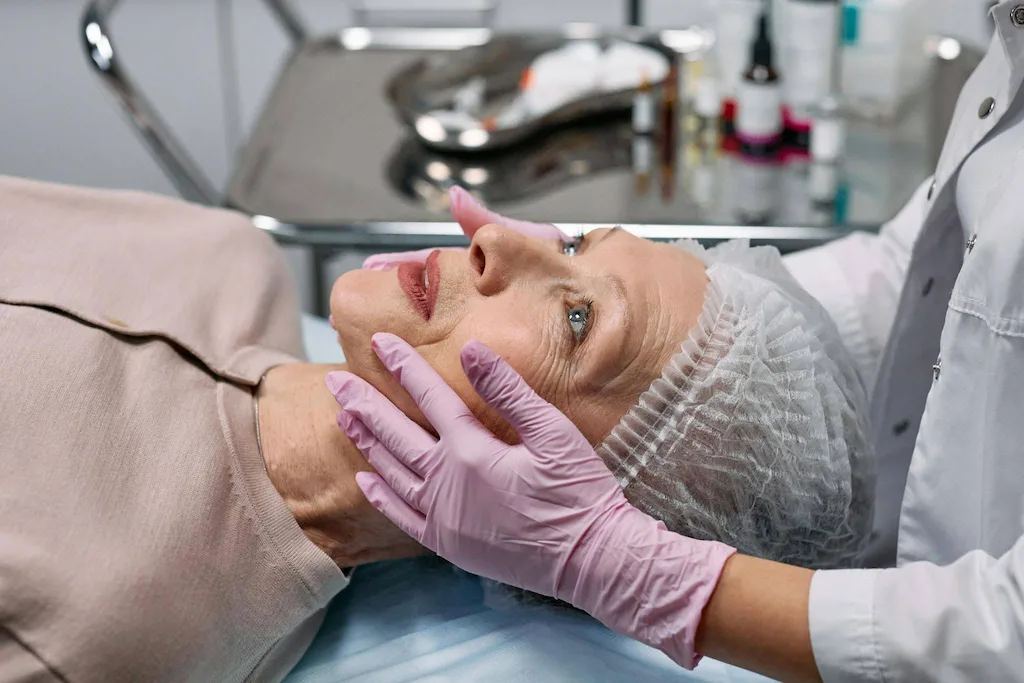
Good candidacy depends more on your anatomy, health, and goals than on reaching a certain age. A facelift is most effective when the visible concerns are within the procedure's scope. These include sagging skin on the lower face and jowls, deep nasolabial folds, and loose skin around the jawline and neck that cannot be improved with creams. When that neck laxity is pronounced, a procedure to improve your neck and chin profile is often combined with the lift.
Most facelift patients are in their late 40s to 60s, a range in which the skin retains enough elasticity to redrape effectively after repositioning. The average age in larger published groups is about 59 years. However, age is just one factor. Many individuals outside this range remain good candidates.
During a consultation, your surgeon considers more than just your skin. A quick cheek pinch test assesses elasticity. Your weight history is important because having a facelift while your weight fluctuates may reduce the longevity of results. It's also essential to discuss health conditions that may slow healing before scheduling the procedure.
Here are the traits that tend to line up with great facelift outcomes.
- You have visible sagging in the lower face, jowls, or neck that bothers you.
- Your skin still has some spring to it when you gently pinch and release.
- You're a nonsmoker or genuinely willing to stop for several weeks before and after surgery.
- Your weight has been fairly steady for at least six months.
- You're generally healthy, with any chronic conditions well-managed.
- Your expectations are grounded: you want to look like a rested version of yourself, not someone else.
Smoking deserves its own note because it has a real effect on the result. Nicotine narrows the tiny blood vessels your skin relies on for healing. That raises the risk of complications such as wider scars or slower wound healing.
Most surgeons ask patients to stop for about four to six weeks before and after surgery. It's one of the most impactful things you can do for yourself. Researching carefully before a decision this personal is exactly the right approach.
What are the different types of facelifts?
"Facelift" is an umbrella term that encompasses various procedures. These techniques address different facial layers and levels of aging. Each is a form of facial rejuvenation surgery in Palm Beach, differing in how deep the lift goes and how long it lasts. The best option depends on your unique anatomy and the amount of change you desire.
Dr. Sistare performs the deep-plane facelift, a procedure that releases the deeper tissue layer instead of merely pulling on the skin. Since the skin and underlying muscle move together, it helps prevent a tight, pulled appearance. Published studies indicate 94.4% patient satisfaction with deep-plane outcomes, though satisfaction greatly depends on the surgeon's expertise.
Here's how the common techniques compare at a glance.
| Technique | What it addresses | How long results last | Typical recovery |
|---|---|---|---|
| Traditional SMAS facelift | Lower face, jowls, jawline | About 7 to 10 years | 2.5 to 3.5 weeks of visible downtime |
| Deep plane facelift | Lower face, jowls, mid-face, neck | About 10 to 15 years | 2.5 to 3.5 weeks of visible downtime |
| Minimal incision facelift (Smartlift) | Bottom of the face and top of the neck | About 3 to 5 years | 7 to 10 days of visible downtime |
| Mid-facelift | Cheeks, nasolabial folds | About 5 to 10 years | 10 to 14 days of visible downtime |
| Liquid facelift (facial balancing) | Fine lines, mild volume loss, slight lift only if skin is already tight | About 1 to 2 years per session | Minimal, same-day recovery |
A minimal incision facelift, which Dr. Sistare also calls a Smartlift, targets the bottom of the face and the top of the neck. It uses a smaller scar than a full face or neck lift and suits individuals in their 40s or early 50s who are beginning to notice jowling but still have healthy skin tone. A mid-facelift targets the central cheeks and the lines extending from the nose to the mouth. A liquid facelift is similar to what some call facial balancing and is performed by our injector Jackie using filler and other injectable cosmetic treatments. It can provide some mild lifting, but the skin needs to be relatively tight already.
If you're wondering which you're best suited for, seeing real before-and-after examples is often more helpful than another comparison chart. Looking at patients with a starting point similar to yours grounds your expectations in something real.
How is facelift surgery performed?
On the day of your surgery, you arrive at an outpatient surgery center. Most facelifts are done under general anesthesia or intravenous sedation combined with local anesthesia. This ensures you're comfortable and unaware of any sensation during the procedure.
Incisions are made in areas that will be least visible after healing. Typically, facelifts begin at the temple, curve in front of the ear, and extend behind it to the hairline. If a neck lift is part of the procedure, a small additional incision under the chin may be included. The resulting scars usually blend with the natural fold where the ear meets the cheek.
Once the incisions are made, your surgeon works beneath the skin on the SMAS layer. That's the deeper layer of muscle and connective tissue that shapes much of your lower face. Older techniques pulled mainly on the surface. Modern approaches like the deep plane technique reposition this deeper layer, so the skin drapes over a naturally lifted foundation instead of being stretched flat.
Most facelifts take about two to four hours, longer if additional work, such as fat grafting or a neck lift, is combined. Excess fat is sculpted or redistributed, loose skin is trimmed, and the incisions are closed with fine sutures. A light compression dressing is wrapped around your face and neck for the first few hours at home. Small drains are sometimes used and typically removed within a day or two.
Lori S., a patient who wanted every step explained clearly, described her experience:
"Dr. Sistare is amazing, he explains everything perfectly and makes you feel comfortable. He really cares about his patients. The staff is amazing right along with the Surgical center. I have nothing but good things to say about my entire experience."
What is facelift recovery like?

Recovery from a facelift is gradual, with noticeable improvements week by week rather than overnight. If you want the day-by-day version, what recovery looks like week by week breaks down each phase from the first 72 hours onward. The first few days are the quietest. You'll rest with your head elevated, use cold compresses to keep swelling down, and take the pain medication your surgeon prescribes. Dr. Sistare also encourages short walks starting the night of your surgery to support healthy circulation.
Most patients describe the feeling as tightness, pressure, and tenderness rather than sharp pain. The soreness usually eases enough that you can switch to over the counter medication after about three days.
Swelling and bruising follow a predictable curve. Swelling peaks around days three to four, then steadily fades. Bruising is often visible for 10 to 14 days and can usually be concealed with makeup by the second week. By about two weeks, many patients feel ready for desk work or low-key social plans without feeling self-conscious.
Here's the general timeline most patients follow.
| Time after surgery | What's typical | What you're usually doing |
|---|---|---|
| Days 1 to 3 | Peak swelling and bruising, drains (if used), are typically removed | Resting, cold compresses, head elevation, light meals, short walks starting the night of surgery |
| Days 4 to 7 | Swelling begins to settle, first follow-up visit | Light walks around the house, gentle neck movement |
| Week 2 | Bruising fades, most patients return to desk work | Makeup over bruising if needed, no heavy lifting |
| Weeks 3 to 4 | Subtle swelling lingers, shape emerges | Light cardio, social outings, and slowly increasing activity |
| Weeks 4 to 6 | Full physical recovery for most patients | Resumed exercise, daily sunscreen, and lifting restrictions lifted |
| Months 2 to 3 | Final settling, incisions flattening | Unrestricted activity, consistent sun protection |
Taking care of your incisions is straightforward yet crucial. Most surgeons advise gentle cleaning, applying a thin layer of ointment, and keeping your head elevated while lying down. Avoid strenuous activities such as heavy lifting and deep bending for around four to six weeks.
Sun protection becomes a long-term habit, not a short-term rule. UV exposure on fresh scars can leave them darker or thicker. It's okay to have days when you feel impatient with your reflection. Healing isn't linear, and your face will look different in the mornings than in the evenings for a while.
To help plan the broader financial picture for recovery, flexible financing through Cherry, CareCredit, and Alphaeon Credit can spread the cost over monthly payments. That way, the healing timeline isn't tangled up with the payment timeline.

What are the risks and safety considerations for a facelift?
A facelift is a common, well-studied surgery. Overall complication rates are low when patients are carefully selected, and the procedure is performed by an experienced board-certified surgeon. In a large analysis of 11,300 patients, the overall major complication rate sat around 1.8%.
The most common issue is a small blood collection, called a hematoma, beneath the skin, which occurs in about 5% of facelifts. These are usually detected and treated promptly. Only 1% involve major, rapidly growing hematomas that need urgent surgery. Other possible issues include temporary sensory changes around the ears or jawline as nerves recover, slower healing at incision sites, and, in some cases, raised or uneven scars. Infection is rare.
Scarring is one of the most common concerns people worry about. An honest answer: a facelift does leave scars, because it requires incisions. The goal is to place them where they're hardest to see, tucked along the hairline, into the creases around the ear, and sometimes under the chin. With time and sun protection, most facelift scars fade to thin lines that blend into the surrounding skin.
A few things you can actively do to lower your risk:
- Stop smoking at least four weeks before surgery and stay off nicotine for four to six weeks after.
- Keep chronic conditions like blood pressure and diabetes well-controlled in the months leading up.
- Follow medication instructions, including pausing blood thinners and certain supplements on schedule.
- Arrive with realistic expectations and an honest medical history.
- Build a calm, supported recovery space at home before the day of surgery.
- Keep every follow-up visit, even if everything feels fine.
Most people never meet any of these issues. Modern techniques are designed to minimize them, and the vast majority of patients move through the process without a single hiccup.
What facelift results can I expect, and how long do they last?
A successful facelift should make you look like yourself, just more rested. Modern methods, particularly the deep plane technique, steer clear of the tight, stretched appearance that tarnished older facelifts. According to published outcome studies, patients reported looking approximately 6.9 years younger on average post-surgery, aligning with common descriptions: refreshed, not completely changed.
The timeline for seeing results has two parts. Most dramatic swelling resolves within the first three weeks, and by three months, the shape you'll live with is clearly visible. Subtle settling continues for up to six months, especially around the jawline and neck. That's when scars finish softening, too.
Longevity is where the choice of technique really matters. Published data on deep plane techniques suggest results lasting 10 to 15 years, compared with about 7 to 10 years for traditional SMAS approaches. At Palm Beach Cosmetic Surgery, patients are told facelift results can last 10 years or more.
Lifestyle makes a bigger difference than most people expect. Daily sunscreen, steady weight, good sleep, and staying off nicotine all help preserve what you've invested in. Skincare with retinoids and gentle in-office treatments can keep skin tone and texture looking fresh without the need for repeated surgery.
Marilyn S., a patient at our West Palm Beach office who focused on what her finished result would look and feel like, shared:
"Dr. Sistare at Palm Beach Cosmetic Surgery are absolutely amazing! I felt welcomed and cared for. The staff is professional, kind, and attentive. If you're looking for exceptional care and stunning results, this is the place to go. Look no further!"
If you're ready to discuss what's realistic for your face, schedule a consultation and start the conversation with a clear plan.
What happens at a facelift consultation?
Your consultation isn't a sales meeting. It's a two-way evaluation: your surgeon is assessing whether a facelift is the right fit, and you're there to evaluate him and the practice just as carefully.
Your surgeon looks at your anatomy, skin quality, and overall health. That hands-on, in-person assessment is something a screen can't replicate, which is why every consultation at our West Palm Beach office is face-to-face.
The visit usually starts with a thorough conversation about what's been bothering you, what you hope to change, and what you don't want to look like after. From there, Dr. Sistare performs a physical evaluation of your facial structure and skin elasticity. He walks through the technique options suited to your anatomy, explains what a realistic result would look like, and lays out the recovery and timing so nothing is a surprise later.
You'll also have space to talk through the practical pieces. Pricing, financing options, and scheduling around the rest of your life are all fair game. Flexible financing through Cherry, CareCredit, and Alphaeon Credit keeps the conversation about cost part of planning, not a wall between you and your goals.
Bring a list of questions. Nothing is off limits, and a good consultation leaves you with fewer unknowns. When you're ready, book your consultation at our West Palm Beach office.
Conclusion
When you notice your reflection looks older than you feel, it is only natural to want a change. You deserve to look as energetic and vibrant as you feel inside, and a facelift is a powerful way to bridge that gap. It isn’t about changing who you are; it’s about feeling confident in your own skin, every single day.
You now have a clearer picture of what the procedure involves, from the structural “Deep Plane” techniques to the reality of the recovery process. While browsing patient photos is an excellent way to ground your expectations, the most important step is to have a conversation tailored to your goals.
We believe that your aesthetic goals should be within reach. At Palm Beach Cosmetic Surgery, we offer flexible financing options through Cherry, CareCredit, and Alphaeon. These plans allow you to choose a monthly payment that fits your budget, including 0% APR options for qualified patients, so you can focus on your results rather than the upfront cost. To explore financing options, ask us how to pre-qualify without affecting your credit score.
Dr. Sistare and our team are here to ensure your path to looking refreshed is transparent, accessible, and never intimidating.
Take the next step toward the look you’ve been carrying in your head. Schedule your consultation at our West Palm Beach, Florida office or call us today at (561) 786-2112. Your journey to renewed confidence starts now.
Frequently asked questions
How painful is facelift surgery?
Most patients describe the sensation as tightness, pressure, and tenderness rather than sharp pain. Discomfort peaks in the first 48 hours and is well managed with prescription pain medication. Most people transition to over the counter options by about three days after surgery.
How long is the facelift recovery time?
Visible bruising and swelling generally last two to three weeks. Most patients return to desk work within one to two weeks. Full physical recovery takes about four to six weeks, and final results continue to refine over the following months.
How long do facelift results last?
Traditional facelift results typically last 7 to 10 years. Deep plane techniques often last 10 to 15 years. Your genetics, lifestyle, sun exposure, and weight stability all influence where you land within that range.
What is a deep plane facelift?
A deep plane facelift is a modern technique that releases the deeper tissue layer beneath the SMAS, rather than lifting only the skin. Because the skin and muscle stay attached and move together, the result looks more natural and tends to last longer. It's often chosen by patients who want durable, natural-looking rejuvenation.
Can I get a facelift in my 40s?
Yes. Patients in their 40s with early jowling, deepening folds, and good skin elasticity can be excellent candidates, especially for a minimal incision or deep plane facelift tailored to earlier stage aging. The best gauge isn't age on paper but a combination of your facial changes, skin quality, and goals.
Will a facelift make me look unnatural?
When performed by an experienced board-certified surgeon using modern techniques, a facelift looks refreshed, not stretched. The "pulled" look people worry about comes from older skin-only techniques. Deeper approaches reposition the structure underneath, so the skin drapes naturally over a gently lifted foundation.
What are facelift scars like?
Facelift scars are placed where they're hardest to see. They usually tuck into the hairline, curve around the ear, and sometimes run under the chin. With careful incision placement, proper wound care, and consistent sun protection, most scars fade to thin lines over months.
Is a facelift safe for older adults?
Healthy older adults can be good candidates for a facelift, as long as they don't have conditions that significantly impair healing. Age alone isn't a disqualifier. Overall health and well-controlled chronic conditions matter most.
Can fillers replace a surgical facelift?
No. Injectable fillers and neuromodulators can soften fine lines and restore mild volume loss, but they can't lift sagging tissue or remove loose skin. They can complement a facelift, either before you're ready for surgery or years later as maintenance. A surgical lift remains the only way to truly reposition deeper tissues.
How do I prepare for facelift surgery?
Your surgeon will give you a personalized preparation plan. The basics usually include stopping smoking several weeks ahead, pausing blood thinners on schedule, and arranging a calm recovery space at home. A consultation walks you through every step specific to your plan.
**Disclaimer: The information is intended for educational purposes only and should not be considered medical advice. Every patient's anatomy, health history, and goals are unique, and outcomes, recovery timelines, and candidacy may vary. The only way to determine whether the procedure is right for you is through a one-on-one consultation with a board-certified cosmetic surgeon. Always discuss your specific concerns, risks, and expectations with your provider before making any decisions about surgery. The specialty recognition identified herein has been received from a private organization not affiliated with or recognized by the Florida Board of Medicine."